Thanks to all of you for responding to my blog. I had another Proverb ready, but left it in my room. I would go back and get it, but there is a long line for the two computers that are working. I didn't want to give up my spot. I'll bring some more proverbs later. I have a bit of bad news and good news about pictures. The digital camera I brought is broken as far as I know, but the good news is that the rest of the group with whom I am traveling are taking a lot of pictures, so I will eventually be able to download some of them on to the blog.
Yesterday we traveled for our visit to the US Embassy in downtown Accra. The building was like a fortress, and it cost $112 million to build. It actually looked a lot like the Dekalb County Jail, which is next to I - 285 on Memorial Drive (in Atlanta). We were visited by two men, Ben and Chris. I would give you there last names, but we were instructed to leave our backpacks in the bus, so I didn't have anything on which to write their names. Ben was Ghanaian with a PhD. in one of the sciences (I think electrical engineering) who attended Auburn University. After working for 12 years in Alabama, I guess he decided to return home. Ben's job at the US Embassy is to help Ghanaian students figure out which college would be best for them to attend, and then to help them obtain Visas if they are going to attend a college in the United States. Ben was very candid with us and told us that Ghana's educational system is becoming more and more expensive each year. Hence, Ghanaians are required to pay more and more for their children's education. Ben outlined what he believed to be the two biggest problems facing the educational system in Ghana. The first was that not enough resources are being used to further develop research. It seems that value addition is needed for their resources, and greater technology is needed to improve what they have in abundance. The three biggest exports from Ghana are gold, cacao, and timber. The second problem, as well as the first, is one that Ghana shares with many African nations. How do they stop the brain drain that is occurring. In other words, how does the nation of Ghana get students educated abroad to return home. The second person to greet us was a young American (around 30 -35, I would guess) who was a career diplomat. His last assignment was Fiji and now he is in Ghana. He gave us what seemed to be the state department spiel about Ghana, and then kind of dodged, I mean answered a few questions. All and all it was a pretty neat visit. It is the first time I have ever been to an Embassy of any kind.
On the way to the embassy, we were stuck in some major traffic. It took us approximately 45 minutes to cover about six miles from our hotel to the Embassy. It was an entertaining ride especially when Francis (one of our guides) and Seth (our bus driver) were debating whether or not corrupt politics was at play when President Kuofor's son recently was able to purchase a partially built hotel from an established businessman of fifty years (who could not obtain a loan to finish construction), and then obtain the necessary funds to finish the hotel. By the way, the hotel just so happens to be located very near the President's home. Good governance and how to rid itself of corruption is a challenge for Ghana as it is for many other nations.
We then went and exchanged some money so that we could shop for fabric to have either a dress or shirt made. Before Max would let us take any money with us, he took us to a relatively small market, where we were bombarded with sales pitches of all kinds. The little market resembled a closed in open-air market with plenty of stalls of products to buy. My favorite salesman was a man named Brown who delighted in telling me the story of the Sankofa bird as he tried to sell me a sculpted piece. The idea of Sankofa relates to the idea that one can always go back and fix mistakes of the past. The carving is that of a bird with a long beak that is pruning his own back. Brown was charming, warm and of course eager to sell me something. Our conversation ended with him saying,"you name the price, and the product and I will let you have it for that price." We were under strict orders from Max so I bade Brown farewell. If we get back to that spot, I will go and buy something from him. My least favorite seller was a young man, a hawker (a hawker is someone who aggressively tries to self you something without having a booth), who tried to lure me away to "see the beach." Our guides told me afterwards that he would have perhaps try to steal from me. There was never even one consideration of joining him (Thanks to Max). After our little splash in the market, we traveled to Makola Market where our primary goal was to find material for women's dresses, and men's shirts. I picked a material that has Ghana's commemorative fifty year celebration featured. A women named Jocelyn will be taking measurements and sewing the dresses for the women while we will have a tailor, Solomon, make the shirts for us boys. We will where these garments in Kumasi when we meet the Asantahene. Shopping was interesting, but the poverty made me quite sad. The good news is that it didn't seem to have that big of an impact on the Ghanaians walking around nor did it seem to inhibit the efforts of the sellers. One seller even said to me "Wie gehts" to me hoping that I was a German. The competition for sales is quite fierce, but the people are very good- natured about the process. It is considered a slight insult if one does not haggle for a lower price. Actually, bargaining is considered a form of socialization. I've enjoyed it so far.
Today (Wednesday), we attended two lectures at the University of Ghana. The first was by D. K. Tweretu on the political economy of Africa and the debt crisis. The second was by Ohene Konadu on traditional Ghanaian social institutions.
Professor Tweretu presented the problem that many African nations face concerning the amount of money they owe to the World Bank, The International Monetary Fund (IMF), and to individual nations. His lecture moved extraordinarily fast, and it was difficult to get down all of the details, but I think I understood the gist of what he was saying. Here is my interpretation. African nations, including Ghana, began borrowing a lot of money in the late 1950's and early 1960's when they obtained their independence from their European Colonial masters. The problem with the loans was that no one involved seemed to take into account to what extent the loans were actually needed or the ability of the borrowing nations to pay them back. This initial problem form the outset coupled with the misgoverning of many African nations only plummeted the borrowers into deeper debt. The debt has only grown to the point that statistically, each African infant born today has owes $482 at birth. Of course this number continues to grow, and despite international efforts at implementing debt relief programs, African nations, like Ghana, are slipping even further into to trouble. The problem of bringing about a resolution seems to hinge on the fact that creditors can not let go of what is owed them while African nations are struggling to implement any kind of program that can send them on a disciplined path of recovery. To me it seems like a vicious circle. Africans need to work on ways to add value to their natural resources and it seems to me that investors should quit taking advantage of the situation. I do understand that my version of events are a simplification of all that is going on, but I think my account is fairly close. African nations need to be more responsive to their won needs, while the people in positions of advantage need to have more compassion and finally help African nations to develop, not just take their resources.
The second talk of the day had to do with the institutions of family and marriage in traditional Akan society. The extended family is very real. According to an Ewe (the Ewe are a group of people who also inhabit present day Ghana) proverb, the extended family relationship is not like friendship that you can break at any time. There is a consistent support system for all members of the extended family, which includes what we would call in the US the Aunts, Uncles, and cousins. Only in Akan society, there are not really any aunts. My mother's sister is a mother figure who is responsible for taking over if my mother should die. My father's sister is a feminine father figure. In fact the closest thing to an aunt or an uncle would be my mother's brother, who is required (as are all adults) to be an integral part of the child's upbringing. To me the most impressive part of Ghanaian society is the concept of extended family. In the US, a challenge that our society is facing is what to we do with our elderly. The traditional Akan system addressed that because the extended family has always taken care of the elderly. In the US, we have a growing number of extended care facilities for the elderly, but in Ghana (with all its developmental challenges), this is still not a problem. Professor Konadu believes this to be one of Ghana's greatest achievements. I find it difficult to dispute.
Please forgive me for writing in such a hurry tonight. I have not taken time to write with great care. Tomorrow is our first day in which we will be visiting classrooms. I am as nervous as if it were the first day of school. Like always, I wonder if the students will be motivated by me, and I wonder what I will have to offer? I will try to let you know how it went within the next couple of days. Peace out, got nothing but love for you (that was for my friend Miles - I banged my chest twice and extended a peace sign).
Wednesday, July 11, 2007


Monday, July 9, 2007
Arrival in Accra
The following interpretation of this proverb comes from Emmanuel K. A. Asante's Akan Proverbs: Their Origins, Meanings, and Symbolical Representation in Ghanaian Material Cultural Heritage. It was published by Asemba Publishers, Christian Council of Ghana in Accra in 2002. I purchased this piece of literature at the bookstore at the University of Ghana @ Legon.
An Akan proverb goes like this: "Woforo dua pa a, na wopia wo."
Its literal meaning is, "It is when you climb a good tree that you are pushed up."
There is a forest tree in Akan called the Pambewuo. It is a tree that has many branches, which causes children to want to climb it. When a child attempts to climb a pambewuo an elder will shout to discourage the child. The truth is that this type of tree is very brittle and loaded with thorns making it unsafe to climb. In the forest, there are many sturdy trees to climb. If an adult sees a child attempting to climb such a tree, then he or she will encourage the child. Thus, there are Akan wood-carvings, which show a man helping a boy climb a (good) tree.
I think this is a good time to discuss this particular proverb because of where we are in our trip. We arrived yesterday morning, and so far we have done very little as far as organized activity goes. Other than eating a few meals and resting, our our only formal destination (until tonight) has been a bus tour of the University of Ghana @ Legon located just outside of Accra. Many of the participants (me included) are "chomping at the bit" to go into downtown Accra. Max, our leader, has asked us to remain patient and not yet venture into town.
This situation reminds me of the proverb mentioned above. I believe we are waiting so that when we do go into town, we will have a better appreciation of the activities available to us. Every step of this program seems to be geared to mazimize our experience. All of us are here because we desire in our own way to learn more about Africa, indeed more about Ghana, so that we can dispel myths that students, colleagues, and friends have about life here. If Max believes that going into downtown Accra would be like climbing a pambewuo tree, then I think all of the participants can happily wait. We are actually scheduled to visit the Makola Market in downtown Accra tomorrow.
We are staying at the Erata Hotel, which is located between the Kotoka International Airport in Accra and the University of Ghana @ Legon. We toured the very large and spread out university earlier today. It is there where we will be attending lectures both this week and in August when we return to Accra.
The Erata Hotel (http://www.eratahotel.com/) is probably on the scale of a 3-star hotel in the United States. The food in Sohos Restaurant (at the hotel) is served buffet style. The breakfast has been delivered in the English style complete with eggs, hot dogs (instead of sausages), baked beans, and sliced fruit. Toast is an option, and they offer HP brand brown sauce as a condiment. The rooms are clean and air-conditioned. There is also a television in most rooms, which has access to about eight different channels (including CNN and Disney). Last night after dinner, in the bar area, a few of us watched a show entitled, Mentor III. The show features a talent competition that copies American Idol. Only tonight's show featured a theme. Each performer was required to perform a James Brown number. It was interesting watching Ghanaian amateurs interpreting James Brown. I have heard that the judges on American Idol can be quite brutal in their evaluation of talent. If that is true (I have never viewed American Idol), then the judges were true to form as they gave the performers little to be excited about. As one might expect viewers could chime in as to which performer was the best by dialing 888 followed by a code for their favorite performer on their mobile phones. TIGO, the local phone company, was offering selected callers a prize of about 44 new cedis ($50.00) for calling in. The television commercials were interesting also . They were all filled with energy, but my favorite was the commercial that showed women who owned stands in the marketplace discussing Ghana's new currency, the GH cedi, which is replacing the old cedi.
In my spare time yesterday, I joined my friend Andy ( a fellow GPA participnat) on a little walk in the neighborhood surrounding the hotel. Most of the shops have a wood frame with a roof. They are open in the front and are decorated with signs of what is being sold. Many of the shops have names that are faith-based. Here are some examples: Everything by God Fastfood, God is Alive Laundry, The Annointed Hand Supermarket, and the Blood of Jesus Enterprises ( a convenience store). There were a few women sellers cooking corn over a fire in a tub. It was Sunday and there are revolving black-outs (due to a power shortage) of electricity, so the dirt streets were not too busy.
Tonihgt, we drove to Augustina's (Max's wife) house for our welcome dinner. We drove through rush hour traffic at about six o'clock PM. We drove through many dirt roads of neighborhoods that were filled with houses and businesses of all kinds. When we arrived at our destination, we quickly discovered that we were attending a "welcome party" not a welcome dinner. We entered a beautiful room with a large visiting room. The speakers were cranking with disco music from the '70's including Donna Summer, the Ohio Players, and Kool and the Gang. We even got to hear Car Wash by Rose Royce. Later in the evening we listened to contemporary Ghanaian dance music. We ate with drinks available, and we danced for several hours. Our five Ghanaian helpers (Ben, Daniel, Seth, Francis, and Razak) joined us in our celebration. Many of Max's family friends and workers from the University of Ghana also joined in. I think everyone had a good time. We arrived back at the hotel at 11:00 o'clock PM.
Tomorrow, we will visit the U.S. Embassy, the Center for (Ghanaian) National Culture, and the Makola Market - all in downtown Accra. It seems we will begin to climb the good tree.
Check back with the blog!!!
An Akan proverb goes like this: "Woforo dua pa a, na wopia wo."
Its literal meaning is, "It is when you climb a good tree that you are pushed up."
There is a forest tree in Akan called the Pambewuo. It is a tree that has many branches, which causes children to want to climb it. When a child attempts to climb a pambewuo an elder will shout to discourage the child. The truth is that this type of tree is very brittle and loaded with thorns making it unsafe to climb. In the forest, there are many sturdy trees to climb. If an adult sees a child attempting to climb such a tree, then he or she will encourage the child. Thus, there are Akan wood-carvings, which show a man helping a boy climb a (good) tree.
I think this is a good time to discuss this particular proverb because of where we are in our trip. We arrived yesterday morning, and so far we have done very little as far as organized activity goes. Other than eating a few meals and resting, our our only formal destination (until tonight) has been a bus tour of the University of Ghana @ Legon located just outside of Accra. Many of the participants (me included) are "chomping at the bit" to go into downtown Accra. Max, our leader, has asked us to remain patient and not yet venture into town.
This situation reminds me of the proverb mentioned above. I believe we are waiting so that when we do go into town, we will have a better appreciation of the activities available to us. Every step of this program seems to be geared to mazimize our experience. All of us are here because we desire in our own way to learn more about Africa, indeed more about Ghana, so that we can dispel myths that students, colleagues, and friends have about life here. If Max believes that going into downtown Accra would be like climbing a pambewuo tree, then I think all of the participants can happily wait. We are actually scheduled to visit the Makola Market in downtown Accra tomorrow.
We are staying at the Erata Hotel, which is located between the Kotoka International Airport in Accra and the University of Ghana @ Legon. We toured the very large and spread out university earlier today. It is there where we will be attending lectures both this week and in August when we return to Accra.
The Erata Hotel (http://www.eratahotel.com/) is probably on the scale of a 3-star hotel in the United States. The food in Sohos Restaurant (at the hotel) is served buffet style. The breakfast has been delivered in the English style complete with eggs, hot dogs (instead of sausages), baked beans, and sliced fruit. Toast is an option, and they offer HP brand brown sauce as a condiment. The rooms are clean and air-conditioned. There is also a television in most rooms, which has access to about eight different channels (including CNN and Disney). Last night after dinner, in the bar area, a few of us watched a show entitled, Mentor III. The show features a talent competition that copies American Idol. Only tonight's show featured a theme. Each performer was required to perform a James Brown number. It was interesting watching Ghanaian amateurs interpreting James Brown. I have heard that the judges on American Idol can be quite brutal in their evaluation of talent. If that is true (I have never viewed American Idol), then the judges were true to form as they gave the performers little to be excited about. As one might expect viewers could chime in as to which performer was the best by dialing 888 followed by a code for their favorite performer on their mobile phones. TIGO, the local phone company, was offering selected callers a prize of about 44 new cedis ($50.00) for calling in. The television commercials were interesting also . They were all filled with energy, but my favorite was the commercial that showed women who owned stands in the marketplace discussing Ghana's new currency, the GH cedi, which is replacing the old cedi.
In my spare time yesterday, I joined my friend Andy ( a fellow GPA participnat) on a little walk in the neighborhood surrounding the hotel. Most of the shops have a wood frame with a roof. They are open in the front and are decorated with signs of what is being sold. Many of the shops have names that are faith-based. Here are some examples: Everything by God Fastfood, God is Alive Laundry, The Annointed Hand Supermarket, and the Blood of Jesus Enterprises ( a convenience store). There were a few women sellers cooking corn over a fire in a tub. It was Sunday and there are revolving black-outs (due to a power shortage) of electricity, so the dirt streets were not too busy.
Tonihgt, we drove to Augustina's (Max's wife) house for our welcome dinner. We drove through rush hour traffic at about six o'clock PM. We drove through many dirt roads of neighborhoods that were filled with houses and businesses of all kinds. When we arrived at our destination, we quickly discovered that we were attending a "welcome party" not a welcome dinner. We entered a beautiful room with a large visiting room. The speakers were cranking with disco music from the '70's including Donna Summer, the Ohio Players, and Kool and the Gang. We even got to hear Car Wash by Rose Royce. Later in the evening we listened to contemporary Ghanaian dance music. We ate with drinks available, and we danced for several hours. Our five Ghanaian helpers (Ben, Daniel, Seth, Francis, and Razak) joined us in our celebration. Many of Max's family friends and workers from the University of Ghana also joined in. I think everyone had a good time. We arrived back at the hotel at 11:00 o'clock PM.
Tomorrow, we will visit the U.S. Embassy, the Center for (Ghanaian) National Culture, and the Makola Market - all in downtown Accra. It seems we will begin to climb the good tree.
Check back with the blog!!!
Saturday, July 7, 2007
Departure, Destinations, Activities, and Thoughts
"It takes a hard stone to make a sharp blade." These are the words that Nancy Ruther, the associate director of the Whitney and Betty MacMillan Center for International and Area Studies at Yale University, used to describe our leader and director of this program, Max Amoh. She used these words to undoubtedly inspire us participants because Max has put together for us a 43-day schedule that is extraordinarily full and rigorous. Some of you who are reading these entries have read an itinerary that I received by email back in May. As you can imagine preparing a 43-day trip for 15 educators would be very demanding. Well, there is no exception here and our itinerary now is similar, but it has slightly changed. Max has had a habit during our preparation to "fill up the day" with plenty of activities. Max has been true to his form so far; he is "a hard stone" whose goal is to make the participants "a sharp blade" in our shared quest of making the teaching about Africa - regular. More importantly, Max is also a very caring and warm individual. Here is an overview of our itinerary:
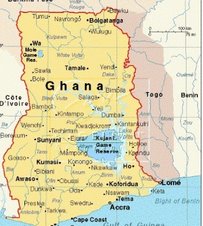
From July 8 - July 17 we will be in Accra and we will travel north throughout most of the country and then back south again. In Accra we will attend lectures at the University of Ghana at Legon; we will visit a local school and be paired with a Ghanaian teacher; we will visit Akosombo, the site of the dam that created Lake Volta; and we will visit Bojo Beach. On July 18 and 19, we will be in the the area surrounding the city of Tamale' where our featured activity will be visiting the Tamale' Islamic Secondary School. From July 20 to July 24, we will travel to the northern city of Bolgatanga where will visit a slave camping site, a crocodile pond and cross over the border into Burkino Faso. While in Bolga we will travel to Sirigu and visit The Sirigu Women's Organization for Pottery and Art (SWOPNA). We will visit yet another secondary school, a chief's palace, a unigue Catholic Orphanage for babies, visit a local market, and attend a cultural show. We will also travel to Tongu to visit another chief and we will visit a cave. We will then travel to Damongo for a guided tour of Mole National Park, and we will also visit a mosque in Larabamga that is over 300 years old. From July 25 - August 2 we will then venture south to Kumasi where we will get paired with another Ghanaian teacher. We will also attend the Akwasidae Festival as guests of the Asantehene (king), and visit the Asanteheman (the queen mother) who selected the Asantehene. We will also visit crafts villages where we will see among other things Kente' cloth being made. We will also visit the Obuasi gold mine (this area was popular to the Europeans for gold before it was popular for human capital - slavery). We will also watch the sunrise at Lake Bosumtwi, a lake created by a meteorite thousands of years ago. From Kumasi we will travel to Cape Coast where from August 3 - 6, we will probably enter the (emotionally) deepest part of our journey as we visit the (slave) castles at Elmina (which is Portuguese for the mines) and at Cape Coast. We will also visit the Nkroful, the hometown of Kwame Nkrumah, the first president of independent Ghana in 1957. From August 7 - August 9 we travel back east to Accra where we will further prepare for our homestays in the Akwapim Mountain Range from August 10 - 13. From August 14 - 19 we will be back in Accra for debriefing and our preparation for return. We leave Ghana on August 19. This recap of our 43 day journey does not include every thing we will do, but I have tried to include activities that seem very significant. I have omitted the fact that we are learning basic (very) Twi, an Akan language, so that we can hopefully engage in one of ghana's most popular activities - bargaining at the market place. We will be visiting many markets along our way.
Max said to us in our meeting last night,"you will see poverty in your face, but people are not destitute." All that we have heard suggests that the Ghanaian people are some of the most accepting and kind people in the world. They would share with us their last piece of food according to Max. I am at a loss of words to explain the range of emotions that are flooding througout me at this moment. We depart from New York in about ten hours and this time tomorrow, we will be about to land in Accra. I have paid close attention to the numerous experts that Max has brought before us. If a better program for teachers than the one that has become a part of me in the last year exists then I hope I am fortunate enough to be a part of it because I feel blessed and I haven't yet set foot in Ghana. I find myself both excited and a little intimidated by the next 43 days. I don't want to make any mistakes (although I am sure I will). I want to learn all I can because I believe educating students and helping other teachers to educate their students about what is happening in Ghana, the rest of Africa, and the rest of the world is vital to the future. For those of you who plan to join me via this blog, I hope I am able to relay to you an important part of this experience. To you I say in Twi, Medaase (Ma' das e') which means thank you. Medaase for joining me. If you enjoy what you read then please encourage others to do so. I do not know how often I will be able to post entries, but I will try to do so often. Until I see all of you again, I simply say good-by in Twi, "ninte yie" which literally means walk well.
From July 8 - July 17 we will be in Accra and we will travel north throughout most of the country and then back south again. In Accra we will attend lectures at the University of Ghana at Legon; we will visit a local school and be paired with a Ghanaian teacher; we will visit Akosombo, the site of the dam that created Lake Volta; and we will visit Bojo Beach. On July 18 and 19, we will be in the the area surrounding the city of Tamale' where our featured activity will be visiting the Tamale' Islamic Secondary School. From July 20 to July 24, we will travel to the northern city of Bolgatanga where will visit a slave camping site, a crocodile pond and cross over the border into Burkino Faso. While in Bolga we will travel to Sirigu and visit The Sirigu Women's Organization for Pottery and Art (SWOPNA). We will visit yet another secondary school, a chief's palace, a unigue Catholic Orphanage for babies, visit a local market, and attend a cultural show. We will also travel to Tongu to visit another chief and we will visit a cave. We will then travel to Damongo for a guided tour of Mole National Park, and we will also visit a mosque in Larabamga that is over 300 years old. From July 25 - August 2 we will then venture south to Kumasi where we will get paired with another Ghanaian teacher. We will also attend the Akwasidae Festival as guests of the Asantehene (king), and visit the Asanteheman (the queen mother) who selected the Asantehene. We will also visit crafts villages where we will see among other things Kente' cloth being made. We will also visit the Obuasi gold mine (this area was popular to the Europeans for gold before it was popular for human capital - slavery). We will also watch the sunrise at Lake Bosumtwi, a lake created by a meteorite thousands of years ago. From Kumasi we will travel to Cape Coast where from August 3 - 6, we will probably enter the (emotionally) deepest part of our journey as we visit the (slave) castles at Elmina (which is Portuguese for the mines) and at Cape Coast. We will also visit the Nkroful, the hometown of Kwame Nkrumah, the first president of independent Ghana in 1957. From August 7 - August 9 we travel back east to Accra where we will further prepare for our homestays in the Akwapim Mountain Range from August 10 - 13. From August 14 - 19 we will be back in Accra for debriefing and our preparation for return. We leave Ghana on August 19. This recap of our 43 day journey does not include every thing we will do, but I have tried to include activities that seem very significant. I have omitted the fact that we are learning basic (very) Twi, an Akan language, so that we can hopefully engage in one of ghana's most popular activities - bargaining at the market place. We will be visiting many markets along our way.
Max said to us in our meeting last night,"you will see poverty in your face, but people are not destitute." All that we have heard suggests that the Ghanaian people are some of the most accepting and kind people in the world. They would share with us their last piece of food according to Max. I am at a loss of words to explain the range of emotions that are flooding througout me at this moment. We depart from New York in about ten hours and this time tomorrow, we will be about to land in Accra. I have paid close attention to the numerous experts that Max has brought before us. If a better program for teachers than the one that has become a part of me in the last year exists then I hope I am fortunate enough to be a part of it because I feel blessed and I haven't yet set foot in Ghana. I find myself both excited and a little intimidated by the next 43 days. I don't want to make any mistakes (although I am sure I will). I want to learn all I can because I believe educating students and helping other teachers to educate their students about what is happening in Ghana, the rest of Africa, and the rest of the world is vital to the future. For those of you who plan to join me via this blog, I hope I am able to relay to you an important part of this experience. To you I say in Twi, Medaase (Ma' das e') which means thank you. Medaase for joining me. If you enjoy what you read then please encourage others to do so. I do not know how often I will be able to post entries, but I will try to do so often. Until I see all of you again, I simply say good-by in Twi, "ninte yie" which literally means walk well.
Saturday, June 30, 2007
Pre-trip thoughts - Preparation
Upon learning that I would be attending Yale University's PIER-African Studies Summer Institute on The Teaching of Africa in July of 2006, I was very excited because I really love the opportunities to learn more about any subject that I will be teaching. The primary reason I applied to attend this workshop was to help myself develop a new class on African Studies. I had always had an interest in Africa primarily because I played soccer with many Africans throughout my life including my roomate in college, Yohannes Worede from Ethiopia. I had also played soccer with men from Nigeria, Sierra Leone, The Gambia, Egypt and South Africa. I found the men to be very interesting and very worldly. When I arrived in New Haven to take the course I knew that I would be exposed to a lot of information, but there was no way I could have known how intense the 10 days would be.
During the first day of the first session the program's director Maxwell Amoh greeted us with a welcome and some details of things we would need to know from a "nuts and bolts" perspective and he then captured my interest with three Akan proverbs. The Akan are a group of people who hail from many parts of West Africa including the area around the city of Kumasi in the nation of Ghana. The Akan make up a significant portion of Ghana's population today. The proverbs and their meanings embody the essencse of why this course and this trip to Ghana appeal to me.
The first proverb that Max uttered was "one must come out of one's house to begin learning." This proverb should remind us of the importance of getting rid of ignorance and misinformation. In a world that often seems very sick it is important that each person in the world does his or her best to understand others. As I have told people of this upcoming trip I am reminded of the streotypes people still have concerning places in Africa. People have made comments like "don't get hit with a poison dart" and "watch out for the wild animals." So, I am leaving "my house" and visiting a new one.
The second proverb was, "If you have not been outside your own farm, you cannot say that you are the only farmer." This proverb teaches us the importance of being careful about your own arrogance. I think the world often suffers dissension because people make the mistake of assuming that their way of doing things is the best. This proverb begs us to be open-minded and to try to learn through personal experiences. I hope I can do this while I am visiting Ghana, and more importantly I hope I can pass this message on to my students in the future.
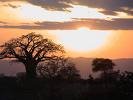
The final of Max's three introductory proverbs was, "Truth is like a baobab tree, one persons arms cannot embrace it." I strongly encourage you to find a picture of a baobab tree to increase your understanding of this proverb. The truth is such a full story. There are so many perspectives on it. Can one persons version of the truth ever be correct? This proverb should also cause one to consider the unkown. What would another participant write about the first meeting we all had together in New Haven last July 6? Would it have the same twist as what I am writing? Certainly for me, there is a lot of "unknown" ahead of me in the next six weeks. I welcome it and invite you to check in with me here while I add these posts.
As our departue approaches I grow more and more excited about the opportunity before me. From the first day of the class last summer Max referred to us as a family. I feel a connection to the professionals that I shared ten intense days of study with followed by four follow up sessions during the '06/'07 school year. Every session we had, whether it was on the geography of the continent or on the politics of developing nations, was intriguing on many levels. The quality of my experience with this group of people has thus far been excellent, and I anticipate a fabulous six weeks.
During the first day of the first session the program's director Maxwell Amoh greeted us with a welcome and some details of things we would need to know from a "nuts and bolts" perspective and he then captured my interest with three Akan proverbs. The Akan are a group of people who hail from many parts of West Africa including the area around the city of Kumasi in the nation of Ghana. The Akan make up a significant portion of Ghana's population today. The proverbs and their meanings embody the essencse of why this course and this trip to Ghana appeal to me.
The first proverb that Max uttered was "one must come out of one's house to begin learning." This proverb should remind us of the importance of getting rid of ignorance and misinformation. In a world that often seems very sick it is important that each person in the world does his or her best to understand others. As I have told people of this upcoming trip I am reminded of the streotypes people still have concerning places in Africa. People have made comments like "don't get hit with a poison dart" and "watch out for the wild animals." So, I am leaving "my house" and visiting a new one.
The second proverb was, "If you have not been outside your own farm, you cannot say that you are the only farmer." This proverb teaches us the importance of being careful about your own arrogance. I think the world often suffers dissension because people make the mistake of assuming that their way of doing things is the best. This proverb begs us to be open-minded and to try to learn through personal experiences. I hope I can do this while I am visiting Ghana, and more importantly I hope I can pass this message on to my students in the future.
The final of Max's three introductory proverbs was, "Truth is like a baobab tree, one persons arms cannot embrace it." I strongly encourage you to find a picture of a baobab tree to increase your understanding of this proverb. The truth is such a full story. There are so many perspectives on it. Can one persons version of the truth ever be correct? This proverb should also cause one to consider the unkown. What would another participant write about the first meeting we all had together in New Haven last July 6? Would it have the same twist as what I am writing? Certainly for me, there is a lot of "unknown" ahead of me in the next six weeks. I welcome it and invite you to check in with me here while I add these posts.
As our departue approaches I grow more and more excited about the opportunity before me. From the first day of the class last summer Max referred to us as a family. I feel a connection to the professionals that I shared ten intense days of study with followed by four follow up sessions during the '06/'07 school year. Every session we had, whether it was on the geography of the continent or on the politics of developing nations, was intriguing on many levels. The quality of my experience with this group of people has thus far been excellent, and I anticipate a fabulous six weeks.
Wednesday, June 13, 2007
Pre-trip thoughts - Acknowledgments
I would like to begin these acknowledgments with the words Robert Farris Thompson used to begin his acknowledgments in his book Flash of the Spirit. He said, "An artist in Nigeria once taught me a proverb: One tree cannot make a forest (Igi kan ki s 'igbo). In other words, a person who does not work together with his colleagues and his friends will not accomplish very much. The recognition of this truth lies with all acknowledgments." I couldn't agree with Thompson's sentiments more, and after the wonderful experience I shared last summer at Yale University's Programs in International Educational Resources (PIER) - African Studies Summer Institute on The Teaching of Africa, I decided it would be a good way to begin to thank many of the people who have contributed to an opportunity of a lifetime - visiting Ghana for six-weeks.
Thus, I first would like to thank the six people who have been a part of my life the longest - my family. I would like to recognize them for being people of extraordinary character who have dedicated large parts of their lives to the service of others. It is through them that I have developed into the person that I am now. So I send this recognition to my Dad and Mom, Frank and Ruby Jewell; to my sister, Teresa Kopshina; and to my three brothers, Chuck Jewell, Michael Jewell, and David Jewell.
Secondly, I would like to thank my very dear and near girlfriend, Virginia McDonough for editing my application and discussing with me my proposal. I want to thank Garry Hill for helping me come up with the idea of trying to extend microcredit loans to entrepreneurs in Ghana. His enthusiasm for life is contagious. I would also like to thank my dear friends Beth and Geordie Narwold for relaying their tales of world travel to me. Without their input, I would have not as easily been willing to pursue such an endeavor.
Next, I would be mistaken if I did not ackowledge my colleagues at the Lovett School. I thank Billy Peebles, Bill Dunkel, and Rick Chase (all supervisors) for being very supportive of my pursuits and for writing my recommendations. I also thank the members of the History Department in the upper school at Lovett who have created a wonderful environment for learning. They are Bill Nichols, Charlie Brooks, Anne Fuentes, Bernadette May-Beaver, Heidi Gray, Robert Sanderson and Jordan Clark. I would like to express my appreciation to the members of the lower school faculty at Lovett who helped my students in the fall of 2006 with their African Studies project. They are Virginia McDonough, Anne Houk, Suzanne Coleman, Rebecca Brown, Andrea Morgan, Jill Melito, Tricia Carter, Margie Vegh, Jeff Morton, Susie Davis, Mallorie Dubugnon, Laura Jernigan, Kim Johnston, Brooke Hight, Sarah Spiers, and Nancy Spetnagel. I also enjoyed my two and a half hour discussion I had with Kingsley Sackey, a Ghanaian, who also happens to be a Lovett parent. His words and thoughts helped me understand the culture and language better than I had to that point. I would also like to thank Laura Deisley, a parent, for helping me to set up this blog. Finally, I would like to thank my colleagues with whom I coach for being supportive of my time away. These fine people are Ed Billingslea, Ken Rau, Tony Patino, Kaseem Ladipo, Steven Drinkell, Rene' Hounglame, Perry McIntyre, Colleen Bailey, Steve Franks, Stacey Noviello, Charlie Finch, Lara Kauffman, and Gavino Asteghene.
At last I believe it is very important to point out that the director of PIER, his staff, the instructors, other guests, and the participants were so valuable in creating this family environment while attending the institute in July of 2006 and during the follow-ups. I would like to recognize those individuals now. The director and his staff are Maxwell Amoh, Lora Lemosy, Jenny Kline, Elizabeth Ludyjan, and Jizhi Ge. the instuctors and guests who shared their knowledge, passion and experiences were Robert Farris Thompson, Bill Foltz, David Baba Coleman, Jimmy Kandeh, Barbara Brown, Dorothy Woodson, Robert Harms, Misty Bastian, Annette Chittenden, Clyde Taylor, Lee Hirsch, Merry Merryfield, Christopher Udry, Mary Kordak, Mohammad Ali Ahmed, Sifa Mpungu, David Simon, Jo Sullivan, Alex Boateng, Serwaa Anokye, Andre' Siamundele, Lesego Malepe, and Trina Mullins. And finally the participants of the Institute who helped create one of the best academic environments possible. The members of the family who won't make the trip are Rita Abessino, Derek Christensen, Jane Creamer, Katie Dooley, Matt Dooley, Susan Garvey, Sadie Jordan, Nicole Means, Jennifer Norcross, Maria Ogren, Dannete Riehle, Joanne Rubin, Christina Silworth, and Nicole Williams. I would like to welcome M. Lynn Roach and Joan Malerba-Foran who will be joining these members of our family who are going to Ghana from July 8, 2007 to August 19, 2007: Kate Burch, Andy Goldman, Sam Hunt, Jennifer Johnson, Ida Malloy (girl don't go to Utah), Mora Martin, Jaimee Mendillo, Susan Parker, Kellee Terkla, Dorothy Verheyen (Hey Dotty Dotty!), Jenny Kline, and Ellen Cummings. Finally, I would like to especially thank Lyn Brignoli for offering her support as an earlier participant on the trip to Ghana.
Jimmy Jewell
Thus, I first would like to thank the six people who have been a part of my life the longest - my family. I would like to recognize them for being people of extraordinary character who have dedicated large parts of their lives to the service of others. It is through them that I have developed into the person that I am now. So I send this recognition to my Dad and Mom, Frank and Ruby Jewell; to my sister, Teresa Kopshina; and to my three brothers, Chuck Jewell, Michael Jewell, and David Jewell.
Secondly, I would like to thank my very dear and near girlfriend, Virginia McDonough for editing my application and discussing with me my proposal. I want to thank Garry Hill for helping me come up with the idea of trying to extend microcredit loans to entrepreneurs in Ghana. His enthusiasm for life is contagious. I would also like to thank my dear friends Beth and Geordie Narwold for relaying their tales of world travel to me. Without their input, I would have not as easily been willing to pursue such an endeavor.
Next, I would be mistaken if I did not ackowledge my colleagues at the Lovett School. I thank Billy Peebles, Bill Dunkel, and Rick Chase (all supervisors) for being very supportive of my pursuits and for writing my recommendations. I also thank the members of the History Department in the upper school at Lovett who have created a wonderful environment for learning. They are Bill Nichols, Charlie Brooks, Anne Fuentes, Bernadette May-Beaver, Heidi Gray, Robert Sanderson and Jordan Clark. I would like to express my appreciation to the members of the lower school faculty at Lovett who helped my students in the fall of 2006 with their African Studies project. They are Virginia McDonough, Anne Houk, Suzanne Coleman, Rebecca Brown, Andrea Morgan, Jill Melito, Tricia Carter, Margie Vegh, Jeff Morton, Susie Davis, Mallorie Dubugnon, Laura Jernigan, Kim Johnston, Brooke Hight, Sarah Spiers, and Nancy Spetnagel. I also enjoyed my two and a half hour discussion I had with Kingsley Sackey, a Ghanaian, who also happens to be a Lovett parent. His words and thoughts helped me understand the culture and language better than I had to that point. I would also like to thank Laura Deisley, a parent, for helping me to set up this blog. Finally, I would like to thank my colleagues with whom I coach for being supportive of my time away. These fine people are Ed Billingslea, Ken Rau, Tony Patino, Kaseem Ladipo, Steven Drinkell, Rene' Hounglame, Perry McIntyre, Colleen Bailey, Steve Franks, Stacey Noviello, Charlie Finch, Lara Kauffman, and Gavino Asteghene.
At last I believe it is very important to point out that the director of PIER, his staff, the instructors, other guests, and the participants were so valuable in creating this family environment while attending the institute in July of 2006 and during the follow-ups. I would like to recognize those individuals now. The director and his staff are Maxwell Amoh, Lora Lemosy, Jenny Kline, Elizabeth Ludyjan, and Jizhi Ge. the instuctors and guests who shared their knowledge, passion and experiences were Robert Farris Thompson, Bill Foltz, David Baba Coleman, Jimmy Kandeh, Barbara Brown, Dorothy Woodson, Robert Harms, Misty Bastian, Annette Chittenden, Clyde Taylor, Lee Hirsch, Merry Merryfield, Christopher Udry, Mary Kordak, Mohammad Ali Ahmed, Sifa Mpungu, David Simon, Jo Sullivan, Alex Boateng, Serwaa Anokye, Andre' Siamundele, Lesego Malepe, and Trina Mullins. And finally the participants of the Institute who helped create one of the best academic environments possible. The members of the family who won't make the trip are Rita Abessino, Derek Christensen, Jane Creamer, Katie Dooley, Matt Dooley, Susan Garvey, Sadie Jordan, Nicole Means, Jennifer Norcross, Maria Ogren, Dannete Riehle, Joanne Rubin, Christina Silworth, and Nicole Williams. I would like to welcome M. Lynn Roach and Joan Malerba-Foran who will be joining these members of our family who are going to Ghana from July 8, 2007 to August 19, 2007: Kate Burch, Andy Goldman, Sam Hunt, Jennifer Johnson, Ida Malloy (girl don't go to Utah), Mora Martin, Jaimee Mendillo, Susan Parker, Kellee Terkla, Dorothy Verheyen (Hey Dotty Dotty!), Jenny Kline, and Ellen Cummings. Finally, I would like to especially thank Lyn Brignoli for offering her support as an earlier participant on the trip to Ghana.
Jimmy Jewell
Subscribe to:
Posts (Atom)