First of all, I was not able to get to a computer during my stay in Cape Coast. I have corrected it now, but I made a mistake on my last blog when I named the the castle in Elmina. For some reason I called it El Camina. The name is Elmina.
We have arrived back in Accra at the Erata Hotel and I am very tired. I am going to write a somewhat light blog at this moment and try to write a more serious blog about the slave castles in the morning.
As we traveled around almost the entire nation of Ghana it has occurred to me a good that there is at least one really good reason why the US soccer team lost to Ghana in the World Cup last summer. In just about every "nook and cranny" of this nation wherever there is the space or there is the time, kids and young adults gather to play football (soccer). I have seen goals made of bamboo; goals made of two sticks in the ground (like when we played at the beach); I have seen people playing in tight little spaces between two housing complexes. I have seen goals with ropes as crossbars. Hardly any of the balls I have seen being used are very nice. I have seen kids playing with tennis balls (old ones not shiny yellow ones), and one of our group members gave some little boys an empty water bottle and they struck up a game with it. What I am saying here is no mystery to anyone who follows soccer in the international world. There are many cultures in many nations in which children and adults play football with a little extra time and a little extra space. My concern for the children of the United States is that it seems the youth do not participate in many activities in a spontaneous way. I am concerned by this because when I see the children and the young adults play here I see them play with an enormous amount of passion. I wonder to what degree are we limiting the passion of children in the United States by our scheduled days that last from sun-up to sundown. I do not know what the solution is, but I believe there must be a way to foster that type of passion in the activities in which our children participate. I went for a stroll in Bolgatanga ( a city in Northern Ghana) a few weeks ago and passed by a school with a football pitch on it. A scrimmage game was in process with about 100 or so people watching. The field was in terrible condition and was mostly covered with a bright orange clay. There was only grass on the north end of the field and in the nw corner the grass was too high to run in. The players ran through the tall grass to desperately get a cross off. The folks watching on the side laughed as the young man stumbled through the weeds. In the twenty minutes I watched I saw the players perform with very good skill and a tactical knowledge of what to do with and without the ball. It was very entertaining football to watch. The players were not bothered by any of the distractions that came there way. This remained true as a pig and a motorcycle (at separate times) crossed the south end of the field. I kept watching until it was too dark for the players to see. It was a very unique and rewarding experience. My challenge to anyone reading this is to try to facilitate (if you can) passion as part of the activities with which children in your life are involved. By doing so, we may find that our children may work a little harder than they do now and they may enjoy what they do even more. I'll try to write again in the morning. Thanks for reading.
Tuesday, August 7, 2007


Friday, August 3, 2007
On to Cape Coast to see the Castles
We are leaving Kumasi today and heading to the coast west of Accra. This is the location of Cape Coast Castle and the one known as Elmina. This will certainly be one of the most moving experiences from a historical and emotional perspective. I will try to post a blog then. See you for now.
Thursday, August 2, 2007
The Weaver by Joan Malerba-Foran
A note from Tohajie: Here is another post from one of our family. Joan is a teacher from New Haven, Connecticut with four years of experience, but a lifetime of reflection. Enjoy...
My post will reflect an experience our group had on Tuesday, July 31st in the Kente-making center of Bonwire. Less than an hour from our hotel, it was a universe beyond my experiences.
First, to not mention Edna St. Vincent Millay's poem The Ballad of the Harp Weaver...what kind of a poetry enthusiast would I be? Those of you who have not read it, please do (read it out loud, slowly, and have a handkerchief nearby). As for Kumasi and the weavers of Kente cloth: nothing I've ever seen prepared me for the experience. It was "almost" many things I know, but not quite. The weavers were working inside a barn-like structure. The solid wood walls only rose for three feet or so, to reach the top of the cathedral-height ceiling was taut wire that formed an open grid. Draped and hanging from the wire walls was a herd of riotous colors; rather than animals or fowl, colors had been corralled.
When a piece of cloth is removed, the bright afternoon sun blazes in, dotting the dusty floor and dark faces in sporadic, geometric shapes. The patches of light, when they fell on a piece of folded fabric across the room, startled the eye to see color to a depth one normally doesn't grasp. Blues bounced, red reared up, yellows leapt, greens galloped--all the colors clashed, collided, banged, and bounced. It was like being caught in a downpour while--somehow--remaining dry. When the light fell on a face bundled in shadow, the body seated in a wooden web of woven cloth, it startled more than the eye: it startled the heart. The room seemed to have luminous coins flung about. I found it hard to concentrate on any one piece because, as fabrics were removed and rehung, beams of light as powerful and as focused as a police officer's flashlight moved about, pulling my eyes along with them.
Outside the locked door, the usual geography of hard-packed red earth, smooth stones, trees patiently crouching on knees and knuckles of roots, stretched in all directions; but inside, we were penned up in a throbbing, pulsing hive of hope and desperate salesmanship. To the men (recently, women have taken on the craft of weaving Kente cloth, but none were working at this location) these strips of fabric represented history, ancestry, culture...but they also represented a sale. In this not too spacious confine there were no walls to separate the buyers from the sellers, and there were an equal number of both, with maybe the sellers slightly outnumbering us. They were so frantic that they seemed to multiply, shoving 12 hands, 8 arms, many mouths: you know the experience? Anyone who has entered, say, a kindergarten classroom knows the kind of energy I'm referring to. It is not bad; it is simply overwhelming. To be the center of so much attention can be disconcerting! At times, I found myself engulfed in 6 or 7 men, all pleading for my attention. Eventually I did purchase a lovely purple cloth threaded with metallic silver, with strips of the "typical" orange-green and geometric-patterned Kente running through it. With my purchase secure in my thin, black plastic bag (a signal that I had bought something and was no longer approachable for a sale), I stepped back against a patch of wall. There, several Kente cloths had been sold and a space had opened in the mesh wall. The sunlight knifed through and fell on the shoulder of a man, one of only two who--side by side--remained weaving through a ll the selling frenzy. I don't know the technical terms for the parts of his machine, or what his motions would technically be called, but then I don't know the names of the moves that a prima ballerina makes and I still enjoy a classical ballet. And where is the beauty in knowing those technical terms? I watched with complete fulfillment as this this man manually operated his wooden machine: the motion of his hips, his fingers, even his ankles and toes. Everything worked together with an economy of movement that defines the word "beautiful." He sat in the position similar to a recumbent bicycle. between each of his big toe and second toe (does that toe have a name like "the index toe?!") was a large button anchored to a frayed thin rope. These lines tethered him to the loom and he pedaled with them. The shuttle (the only term I do know) flew between the cross-running threads from left to right and back again almost faster than my eyes could follow. All this activity was accompanied by a squeak identical to that of a rocking chair on porch floorboards. Creaking wood, the clack of the loom arms, the silent slide of the various parts, all encompassing the living heart of the machine. His eyes never left the loom, never lifted from his work--not even when I snapped several pictures and my flash exploded around him. His eyes never left the space before him. In the midst of the hive of colors, he was methodically producing one strip of black and white Kente cloth embellished with a golden stool design. Every proverb, aphorism, or slogan I knew about patience, diligence, determination, winning, and loyalty came to mind, and they all applied.
I thought about how an ocean away people in my state were (most likely) complaining about the cost of an item. I realized that bargaining with the one who produces a work is very different from demeaning the newly-hired salesperson about an item he or she had no connection to, other than a weekly paycheck. I thought about how most everything comes from some source outside of my own self, and if I am not the patient producer of that object, I should not accept or give complaints.
When I left he was still sitting at his loom pedaling. In my mind, he will always be there--it is the only memory I have of him. It is the only photograph that I was able to take. It will always be the only way I know him. When I lift a piece of Kente, I will bring it to my ear, and I will imagine I hear the creak of his machine, the rhythm of his fingers feeding thread into its mouth to make fabric, and I'll see the swallowing and the surfacing of those brilliant threads. To me, he is that cloth. What, I wonder, am I?
My post will reflect an experience our group had on Tuesday, July 31st in the Kente-making center of Bonwire. Less than an hour from our hotel, it was a universe beyond my experiences.
First, to not mention Edna St. Vincent Millay's poem The Ballad of the Harp Weaver...what kind of a poetry enthusiast would I be? Those of you who have not read it, please do (read it out loud, slowly, and have a handkerchief nearby). As for Kumasi and the weavers of Kente cloth: nothing I've ever seen prepared me for the experience. It was "almost" many things I know, but not quite. The weavers were working inside a barn-like structure. The solid wood walls only rose for three feet or so, to reach the top of the cathedral-height ceiling was taut wire that formed an open grid. Draped and hanging from the wire walls was a herd of riotous colors; rather than animals or fowl, colors had been corralled.
When a piece of cloth is removed, the bright afternoon sun blazes in, dotting the dusty floor and dark faces in sporadic, geometric shapes. The patches of light, when they fell on a piece of folded fabric across the room, startled the eye to see color to a depth one normally doesn't grasp. Blues bounced, red reared up, yellows leapt, greens galloped--all the colors clashed, collided, banged, and bounced. It was like being caught in a downpour while--somehow--remaining dry. When the light fell on a face bundled in shadow, the body seated in a wooden web of woven cloth, it startled more than the eye: it startled the heart. The room seemed to have luminous coins flung about. I found it hard to concentrate on any one piece because, as fabrics were removed and rehung, beams of light as powerful and as focused as a police officer's flashlight moved about, pulling my eyes along with them.
Outside the locked door, the usual geography of hard-packed red earth, smooth stones, trees patiently crouching on knees and knuckles of roots, stretched in all directions; but inside, we were penned up in a throbbing, pulsing hive of hope and desperate salesmanship. To the men (recently, women have taken on the craft of weaving Kente cloth, but none were working at this location) these strips of fabric represented history, ancestry, culture...but they also represented a sale. In this not too spacious confine there were no walls to separate the buyers from the sellers, and there were an equal number of both, with maybe the sellers slightly outnumbering us. They were so frantic that they seemed to multiply, shoving 12 hands, 8 arms, many mouths: you know the experience? Anyone who has entered, say, a kindergarten classroom knows the kind of energy I'm referring to. It is not bad; it is simply overwhelming. To be the center of so much attention can be disconcerting! At times, I found myself engulfed in 6 or 7 men, all pleading for my attention. Eventually I did purchase a lovely purple cloth threaded with metallic silver, with strips of the "typical" orange-green and geometric-patterned Kente running through it. With my purchase secure in my thin, black plastic bag (a signal that I had bought something and was no longer approachable for a sale), I stepped back against a patch of wall. There, several Kente cloths had been sold and a space had opened in the mesh wall. The sunlight knifed through and fell on the shoulder of a man, one of only two who--side by side--remained weaving through a ll the selling frenzy. I don't know the technical terms for the parts of his machine, or what his motions would technically be called, but then I don't know the names of the moves that a prima ballerina makes and I still enjoy a classical ballet. And where is the beauty in knowing those technical terms? I watched with complete fulfillment as this this man manually operated his wooden machine: the motion of his hips, his fingers, even his ankles and toes. Everything worked together with an economy of movement that defines the word "beautiful." He sat in the position similar to a recumbent bicycle. between each of his big toe and second toe (does that toe have a name like "the index toe?!") was a large button anchored to a frayed thin rope. These lines tethered him to the loom and he pedaled with them. The shuttle (the only term I do know) flew between the cross-running threads from left to right and back again almost faster than my eyes could follow. All this activity was accompanied by a squeak identical to that of a rocking chair on porch floorboards. Creaking wood, the clack of the loom arms, the silent slide of the various parts, all encompassing the living heart of the machine. His eyes never left the loom, never lifted from his work--not even when I snapped several pictures and my flash exploded around him. His eyes never left the space before him. In the midst of the hive of colors, he was methodically producing one strip of black and white Kente cloth embellished with a golden stool design. Every proverb, aphorism, or slogan I knew about patience, diligence, determination, winning, and loyalty came to mind, and they all applied.
I thought about how an ocean away people in my state were (most likely) complaining about the cost of an item. I realized that bargaining with the one who produces a work is very different from demeaning the newly-hired salesperson about an item he or she had no connection to, other than a weekly paycheck. I thought about how most everything comes from some source outside of my own self, and if I am not the patient producer of that object, I should not accept or give complaints.
When I left he was still sitting at his loom pedaling. In my mind, he will always be there--it is the only memory I have of him. It is the only photograph that I was able to take. It will always be the only way I know him. When I lift a piece of Kente, I will bring it to my ear, and I will imagine I hear the creak of his machine, the rhythm of his fingers feeding thread into its mouth to make fabric, and I'll see the swallowing and the surfacing of those brilliant threads. To me, he is that cloth. What, I wonder, am I?
Wednesday, August 1, 2007
Crafts in Kumasi
When I first read that Kumasi was the cultural center of Ghana I was not certain what was meant by that. It never ceases to amaze me the value of experience and being an eye-witness.
Here in Kumasi, we have dedicated all of our formal activity to experiencing first hand some of the cultural richness of the Asante region. The Asante region of which Kumasi is the capital is also the center of the Akan civilization that I talked about many blog entries ago.
I will spend the first part of this post talking about three more craft visits we have made. In the last blog I already referred to the talented bronze worker. In our travels we have seen many of the bronze pieces available for sale. Our next visit on Monday morning was to a village called Pankronu where women control the pottery industry. A very old woman whose name I did not get danced and pranced around while she explained to us (with and interpreter) her craft. Actually, she and three other women whipped up from molds of clay about five different pieces in the space of about 20 minutes. We were sitting in plastic chairs in the middle of the village watching as other potters sat around and watched. We were exposed to a little drama when another potter arrived late and she was fussing at the others because they hadn't called her. It was funny to see the others scold her for her rude behavior as the show went on. After putting down their pieces so they could dry (in the misty rain) our host explained the process to us. In our question and answer session it was revealed to us that only women worked in pottery. In fact because the women went to the clay pits topless (because of the mess I'm sure) a man would be looked on very badly if he was anywhere around when women were gathering clay. It then started to rain harder so we went inside our host's house and she continued answering questions. The most interesting thing I learned here was that they didn't fire their works until they had about 1000 of them. And then they hauled them all to the outskirts of town where they made a huge fire and cooked the pieces there. When they were the most successful, the word would spread that the women of Pankronu were firing their pots and buyers would show up and buy them straight from the fire. The ones that didn't sell were transported back to the village by the women who made them. As we prepared to leave all of the potters who visited us boarded our bus to shake our hands one more time. Of course, our hoist danced her way through. These women were a pleasure to see.
Our next stop was in the village of Ahwiaa the home of the tradition of stool carving. These craftsmen used a variety of axes, knives, and forges to create some of the most beautiful stools I have ever seen. I was surprised to learn that for the men they shape the seats with a round shape while the stools for women are flat across the top. They make the benches out of hardwoods like teak, mahogany, cedar, and sese. Sese is the most durable wood and they make the most important benches out of it. For instance if a new Asantahene (king) was enstolled) they would make his new stool from sese. The tools these artists used were long and awkward looking to me, but these guys handled them with the greatest of skill. When we were turned loose to browse amongst the various shops of stools and other pieces made from wood, I was moved by the quality and made three purchases which will be very interesting to show students. One piece was a stool with the Sankofa symbol. The Sankofa is a bird that looks to his own back, and means that it is always permissible to go back and fix things you didn't quite get right the first time. The stool is a dark brown and is simply beautiful. I also bought a mask which is pretty simple in design. I think it is the simplicity which makes it so beautiful. And my final piece I bought was a sculpture that represents three movable people carved from one piece of wood. It is called unity. Family, community, and unity are revered here as qualities of life way more important than wealth. It is actually quite refreshing.
We then ate lunch and went to Ntonso to meet Percy Anquah who specialized in the making of Adinkra cloth. The adinkra process is where cloth is decorated by the use of stamps which have proverbial meanings. The artists skill was excellent as he created beautiful cloth almost without effort. This was a particularly even more fun stop for us because we all got to make a small piece for ourselves. For my two little squares I chose the crescent which means faithfulness and this design that represents a crocodile and the saying that goes with it is the crocodile lives in the water but breathes the air. It is a symbol that stresses the importance of adaptability. A common misconception of many people in the west is that Africans practice animism, but the truth is they simply use animals to depict the behavior of everyday people. The proverbs are very interesting.
We also visited the village of Bonwire to see how Kente cloth was made. The weavers who are traditionally male, but now a few women to practice it, are very talented. The demonstration they gave was extraordinarily brief. I am sure they just wanted to sell their works to this "group of Americans" who were ready to buy. The selling techniques of the artists was much to high pressure for me so I didn't purchase anything. The talent of making kente cloth traditionally comes from carefully watching a spider weave his web. It is a fantastic skill and the designs on the cloth tell a story much like that of the adinkra.
I have a surprise for you as I am trying to prod my traveling companions to post a blog. The first one willing to do so is Susan Parker, a 38 year teaching veteran from Fayetteville, North Carolina. The posting after this one is from Susan.
Here in Kumasi, we have dedicated all of our formal activity to experiencing first hand some of the cultural richness of the Asante region. The Asante region of which Kumasi is the capital is also the center of the Akan civilization that I talked about many blog entries ago.
I will spend the first part of this post talking about three more craft visits we have made. In the last blog I already referred to the talented bronze worker. In our travels we have seen many of the bronze pieces available for sale. Our next visit on Monday morning was to a village called Pankronu where women control the pottery industry. A very old woman whose name I did not get danced and pranced around while she explained to us (with and interpreter) her craft. Actually, she and three other women whipped up from molds of clay about five different pieces in the space of about 20 minutes. We were sitting in plastic chairs in the middle of the village watching as other potters sat around and watched. We were exposed to a little drama when another potter arrived late and she was fussing at the others because they hadn't called her. It was funny to see the others scold her for her rude behavior as the show went on. After putting down their pieces so they could dry (in the misty rain) our host explained the process to us. In our question and answer session it was revealed to us that only women worked in pottery. In fact because the women went to the clay pits topless (because of the mess I'm sure) a man would be looked on very badly if he was anywhere around when women were gathering clay. It then started to rain harder so we went inside our host's house and she continued answering questions. The most interesting thing I learned here was that they didn't fire their works until they had about 1000 of them. And then they hauled them all to the outskirts of town where they made a huge fire and cooked the pieces there. When they were the most successful, the word would spread that the women of Pankronu were firing their pots and buyers would show up and buy them straight from the fire. The ones that didn't sell were transported back to the village by the women who made them. As we prepared to leave all of the potters who visited us boarded our bus to shake our hands one more time. Of course, our hoist danced her way through. These women were a pleasure to see.
Our next stop was in the village of Ahwiaa the home of the tradition of stool carving. These craftsmen used a variety of axes, knives, and forges to create some of the most beautiful stools I have ever seen. I was surprised to learn that for the men they shape the seats with a round shape while the stools for women are flat across the top. They make the benches out of hardwoods like teak, mahogany, cedar, and sese. Sese is the most durable wood and they make the most important benches out of it. For instance if a new Asantahene (king) was enstolled) they would make his new stool from sese. The tools these artists used were long and awkward looking to me, but these guys handled them with the greatest of skill. When we were turned loose to browse amongst the various shops of stools and other pieces made from wood, I was moved by the quality and made three purchases which will be very interesting to show students. One piece was a stool with the Sankofa symbol. The Sankofa is a bird that looks to his own back, and means that it is always permissible to go back and fix things you didn't quite get right the first time. The stool is a dark brown and is simply beautiful. I also bought a mask which is pretty simple in design. I think it is the simplicity which makes it so beautiful. And my final piece I bought was a sculpture that represents three movable people carved from one piece of wood. It is called unity. Family, community, and unity are revered here as qualities of life way more important than wealth. It is actually quite refreshing.
We then ate lunch and went to Ntonso to meet Percy Anquah who specialized in the making of Adinkra cloth. The adinkra process is where cloth is decorated by the use of stamps which have proverbial meanings. The artists skill was excellent as he created beautiful cloth almost without effort. This was a particularly even more fun stop for us because we all got to make a small piece for ourselves. For my two little squares I chose the crescent which means faithfulness and this design that represents a crocodile and the saying that goes with it is the crocodile lives in the water but breathes the air. It is a symbol that stresses the importance of adaptability. A common misconception of many people in the west is that Africans practice animism, but the truth is they simply use animals to depict the behavior of everyday people. The proverbs are very interesting.
We also visited the village of Bonwire to see how Kente cloth was made. The weavers who are traditionally male, but now a few women to practice it, are very talented. The demonstration they gave was extraordinarily brief. I am sure they just wanted to sell their works to this "group of Americans" who were ready to buy. The selling techniques of the artists was much to high pressure for me so I didn't purchase anything. The talent of making kente cloth traditionally comes from carefully watching a spider weave his web. It is a fantastic skill and the designs on the cloth tell a story much like that of the adinkra.
I have a surprise for you as I am trying to prod my traveling companions to post a blog. The first one willing to do so is Susan Parker, a 38 year teaching veteran from Fayetteville, North Carolina. The posting after this one is from Susan.
Sunday, July 29, 2007
Activities and Observations in Kumasi
Kumasi is certainly a lot more busy than the Bolgatanga area. According to one set of statistics Kumasi is the largest (in pop.) city in Ghana. Its culture explodes out at you a little more than in Accra. We are staying at a very nice hotel called the Hotel Rexmar. Like the Erata in Accra, it has a nice pool area with bar (they even sell pizzas). There is AC in the rooms and a TV with a few channels available. Yesterday I watched parts of a Valencia/Inter Milan match. I watched a portion of a Namibia/Botswana friendly, and a little part of a Lethoso/Angola friendly. Our schedule is extraordinarily busy so I don't really have time to lounge around watching football all day.
The other day when we were visiting the Kwame Nkrumah University of Science and Technology (KNUST), we visited the art department. I am always very moved especially by student art. It is a subject that I now wish I had devoted more time to when I was younger. One piece of sculpture that I really enjoyed was a piece that was done with the following theme as the assignment: Premarital sex has two face. The piece was a sculpture that protruded from a board. One side of the face looked bright and peachy and full of life, while the other side was distorted and confused. I could not help but wonder if the artist meant that premarital sex can have its good feelings, but can also cause aids (there are tons of public service billboards warning against the dangers of unsafe sex practices and virginity in general). Or did the artist mean that premarital sex was psychologically damaging at too young of an age? I was discussing this with Ida Malloy (one of our group) who said she wasn't sure either, but she did say that art was therapeutic and to that I agreed.
On Friday, we were able to shed the weight of our school gifts as we paid a visit to our last schools. We had the option of choosing one of two junior secondary schools (middle schools), or one primary school (elementary school). I chose the elementary school. I went in armed with a Polaroid camera and a few sample of American currency. At first I asked the students about the leaders of Ghana. Almost all of them knew that Kwame Nkruhma was the first president of Ghana (1957). None of them knew that George Washington was the first pres. of the US. I showed them some currency and they showed me some of theirs. It was a fun exchange. I then began milling around during their lunch break. The name of the school I visited was the Kokoben Primary School. There is no lunch room, but the school contracts out to a nearby kitchen to have lunch brought in around 10:30 AM. When lunch arrives the students get about an hour to mill around and do whatever they want. I would have liked to have been that proverbial fly on the wall so I could have seen what they would have done if five Americans (obroni, as foreigners are called) had not been in their midst. After they had eaten (in about ten minutes) the children swarmed around Ellen Cummings, Jennifer Johnson, Mora Martin, Susan Parker and me. With cameras flashing the students would strike funny poses and run up to the digital camera to see what they looked like. They would usually get a big chuckle. We then started to organize smaller group shots (by grade) with the one Polaroid camera we had. I taught them to say cheese on three, which they didn't really understand ( I am not sure I have ever fully understood as I have never really understood if cheese has brought about the desired smile). I then was standing in a big crowd of little ones so I asked them to sing me a song. They broke out into a song that goes like this: I am H - A - P - P - Y; I am H - A - P - P - Y; I am sure I am; I know I am; I am H - A - P - P- Y HAPPY!!!!!. They would clap in rhythm with each letter they spoke.
After a little while they returned to their classes and I went to fourth grade class where the students were permitted to ask any question they wanted. I was having a really good time when Jennifer had come by and said it was time for us to go. We had to pick up the others from the other two schools and get on to participate in a local ceremony the shrine of a priest.
One of the most interesting parts of being here in Ghana has been that we will be driving down some road and turn into a very packed-in housing complex (like the one we visited in Tongu), and stop the bus in go inside. Well, this is what we did after having a late lunch on our school visit day. As soon as we arrived several young men and women saw to it that all of us had a place to sit. We lined the perimeter of a meeting area in the priest's house. I wasn't ready for what was going to happen next. All of a sudden it started to rain (and rain hard). We retreated to a small room where we participated in a ceremony where we were poured a little bit of gin. You poured a little on the ground to offer to the gods and drank the rest yourself. After doing that the rain had slowed and we returned to the meeting area and drummers started playing. A group of women off to one side started dancing when a priestess dressed in a black and white wrap and covered with clay dust started dancing. She had what looked like a horse's tail (although I don't believe it was an actual tail) in one hand and a ceremonial blade in the other. She danced around for a few minutes and went back inside. Then another woman began dancing closer to us seemingly to show us how to get into what was happening. Then the priestess reappeared and Lynn (one of us) was pulled out onto the floor. As Lynn put it later, she gave it he best "clubbin' " effort. I thought she did alright. Slowly all of us sere asked to join in. We had to take off our shoes and do our best to interpret what to do. We were then asked to sit down and the priestess disappeared again. She then reemerged with a live chicken. I then got a sinking feeling for a moment because I didn't really want to watch a chicken get killed. But in rhythmic fashion while dancing she rang the chicken's neck (she did not let go of the chicken until the ceremony was over. We then were all asked to dance with her again. She chose several of us to dance with the whisky thing or the ceremonial blade. She then threw clay dust on us and later a mixture of charcoal and gin was rubbed on our legs (while dancing). As the dancing was winding down, we were all told to tell an egg what it is we were praying for. We then one by one went into her shrine and knelt before her and to ourselves said our prayer. It was really a unique experience. We have not yet had the time to debrief with Agya Koo Nimo, but I will try to remember to tell you what it all meant. Well, it is early in the morning here (about 7:15). I am going to return to my room to bathe and get ready for breakfast. Today, we are attending the Akwasidae Festival. Yesterday, we also attended a funeral. I will try to write about the funeral and the festival next. See you then. Tohajie!!!
The other day when we were visiting the Kwame Nkrumah University of Science and Technology (KNUST), we visited the art department. I am always very moved especially by student art. It is a subject that I now wish I had devoted more time to when I was younger. One piece of sculpture that I really enjoyed was a piece that was done with the following theme as the assignment: Premarital sex has two face. The piece was a sculpture that protruded from a board. One side of the face looked bright and peachy and full of life, while the other side was distorted and confused. I could not help but wonder if the artist meant that premarital sex can have its good feelings, but can also cause aids (there are tons of public service billboards warning against the dangers of unsafe sex practices and virginity in general). Or did the artist mean that premarital sex was psychologically damaging at too young of an age? I was discussing this with Ida Malloy (one of our group) who said she wasn't sure either, but she did say that art was therapeutic and to that I agreed.
On Friday, we were able to shed the weight of our school gifts as we paid a visit to our last schools. We had the option of choosing one of two junior secondary schools (middle schools), or one primary school (elementary school). I chose the elementary school. I went in armed with a Polaroid camera and a few sample of American currency. At first I asked the students about the leaders of Ghana. Almost all of them knew that Kwame Nkruhma was the first president of Ghana (1957). None of them knew that George Washington was the first pres. of the US. I showed them some currency and they showed me some of theirs. It was a fun exchange. I then began milling around during their lunch break. The name of the school I visited was the Kokoben Primary School. There is no lunch room, but the school contracts out to a nearby kitchen to have lunch brought in around 10:30 AM. When lunch arrives the students get about an hour to mill around and do whatever they want. I would have liked to have been that proverbial fly on the wall so I could have seen what they would have done if five Americans (obroni, as foreigners are called) had not been in their midst. After they had eaten (in about ten minutes) the children swarmed around Ellen Cummings, Jennifer Johnson, Mora Martin, Susan Parker and me. With cameras flashing the students would strike funny poses and run up to the digital camera to see what they looked like. They would usually get a big chuckle. We then started to organize smaller group shots (by grade) with the one Polaroid camera we had. I taught them to say cheese on three, which they didn't really understand ( I am not sure I have ever fully understood as I have never really understood if cheese has brought about the desired smile). I then was standing in a big crowd of little ones so I asked them to sing me a song. They broke out into a song that goes like this: I am H - A - P - P - Y; I am H - A - P - P - Y; I am sure I am; I know I am; I am H - A - P - P- Y HAPPY!!!!!. They would clap in rhythm with each letter they spoke.
After a little while they returned to their classes and I went to fourth grade class where the students were permitted to ask any question they wanted. I was having a really good time when Jennifer had come by and said it was time for us to go. We had to pick up the others from the other two schools and get on to participate in a local ceremony the shrine of a priest.
One of the most interesting parts of being here in Ghana has been that we will be driving down some road and turn into a very packed-in housing complex (like the one we visited in Tongu), and stop the bus in go inside. Well, this is what we did after having a late lunch on our school visit day. As soon as we arrived several young men and women saw to it that all of us had a place to sit. We lined the perimeter of a meeting area in the priest's house. I wasn't ready for what was going to happen next. All of a sudden it started to rain (and rain hard). We retreated to a small room where we participated in a ceremony where we were poured a little bit of gin. You poured a little on the ground to offer to the gods and drank the rest yourself. After doing that the rain had slowed and we returned to the meeting area and drummers started playing. A group of women off to one side started dancing when a priestess dressed in a black and white wrap and covered with clay dust started dancing. She had what looked like a horse's tail (although I don't believe it was an actual tail) in one hand and a ceremonial blade in the other. She danced around for a few minutes and went back inside. Then another woman began dancing closer to us seemingly to show us how to get into what was happening. Then the priestess reappeared and Lynn (one of us) was pulled out onto the floor. As Lynn put it later, she gave it he best "clubbin' " effort. I thought she did alright. Slowly all of us sere asked to join in. We had to take off our shoes and do our best to interpret what to do. We were then asked to sit down and the priestess disappeared again. She then reemerged with a live chicken. I then got a sinking feeling for a moment because I didn't really want to watch a chicken get killed. But in rhythmic fashion while dancing she rang the chicken's neck (she did not let go of the chicken until the ceremony was over. We then were all asked to dance with her again. She chose several of us to dance with the whisky thing or the ceremonial blade. She then threw clay dust on us and later a mixture of charcoal and gin was rubbed on our legs (while dancing). As the dancing was winding down, we were all told to tell an egg what it is we were praying for. We then one by one went into her shrine and knelt before her and to ourselves said our prayer. It was really a unique experience. We have not yet had the time to debrief with Agya Koo Nimo, but I will try to remember to tell you what it all meant. Well, it is early in the morning here (about 7:15). I am going to return to my room to bathe and get ready for breakfast. Today, we are attending the Akwasidae Festival. Yesterday, we also attended a funeral. I will try to write about the funeral and the festival next. See you then. Tohajie!!!
Saturday, July 28, 2007
A New Tale in Kumasi
Donald Amuar, our leader while we we were in the northern parts of Ghana, informed us that we are all implicated in the events of history. He said this as we were debriefing after our visit to the Pinkora Slave Camp. He followed up by saying that there is no reason for us to hide from what has happened. I am trying to apply that way of thinking to my experiences here. My younger brother, David, who is a 19 year veteran in the army (I think he is a Lt. Colonel by now) has told me that it usually takes him about two weeks before a newly visited nation begins to appear not so different to his eyes. I would have to say that that was good advice because now that I am three weeks into my visit (the half-way point), I am not seeing the poverty the same way; I am not seeing the challenges this nation faces the same way. I am beginning to see how this country is dealing with those challenges, and although they are very poor economically (compared to the US) how they are in the process of growing their economy. So when I hear Donald say that we are all implicated in the events of history, I am hearing him ask what is it that an individual proposes to do about it. I am not sure what the answer to that is, but I want to comment on it now.
Agya Koo Nimo (AKN for this posting), a legendary Ghanaian musician, is our leader while we are in the Kumasi area. His band has been asked to travel to Cote D'Ivoire early next week so we have packed a bulk of our work in Kumasi to the first five days we are here. We have just finished day three. On our first night, AKN brought his band of drummers, guitarists and dancers to perform for us. As we learned in the north it is acceptable to reward the band by placing a Cedi on the forehead of one of the dancers. It was raining on the pool deck and the dancing was good so I rewarded his efforts. The entire group splits all the money they collect. After the dancing portion of the show, AKN brought us in closer as he and his band acoustically performed for us. He would tell the story about which he was going to sing and then perform. I am going to relay two of those stories to you now. One was about a very old man who was who was planting a coconut tree. When his grandson saw this, he asked his grandfather, "Grandfather, why are you working so hard on a tree that you will never see grow to bear fruit?" The grandfather answered because it will connect me to the ancestors and it will help provide for you and your family for years to come. the grandfather continued by saying that we do these things because it connects us to the past and the future and that these links are very important. It also I believes shows the importance of working hard today for things they may never directly benefit us. It was very soft and soothing song that I enjoyed very much. There were 3 guitarists (one of which was AKN), and several percussion performers playing a variety of instruments. AKN was singing and there were back-up singers who provided nice rhythm with gentle clapping.
The next story I am going to tell you I took as a personal challenge for my visit here. I have also tied to the message I took with me from Donald during my visit to the north. AKN told a story that he said relates to nation-building. Before i can tell you the story it is important that you realize that the rainy season in Ghana lasts about four months from June to October, and then there is the dry season. The song the band performed was about how the ants work hard during the dry season, so that they could rest and enjoy the fruits of their labor during the rainy season. This is of course an age-old story told all over the world, but it helped me to see something about my goal for this visit. One of the reasons for this visit is so that I can learn how to teach about Africa without all of the stereotypes (like Tarzan, jungles and wild animals all over the place). I also planned to come to figure out a way if I could somehow help the people of Ghana. As I stay here longer I realize that Ghana and the Ghanaian people like the people of any nation must address their own challenges in their own way. A group of people must have ownership and the best way to help a group is to give them what they need not what you believe they need. I think one of the weaknesses of the west helping developing nations in the past is that it has lent assistance with too many strings attached. It is hard for us to lend what we term "humanitarian" aid to someone without putting our stamp of morality on it. This relates to the story of the ants because I see the Ghanaian people working hard within a system that they are developing to become a nation that adheres to solid democratic ideals. These ideals are patterned after those of the British or the US, but they are in the end, Ghanaian. They are filled with Ghanaian tradition and Ghanaian custom. The Ghanaian people know what challenges that they are facing, and would probably benefit from further assistance from the west, but not if that assistance forces them to conduct in practices they don't believe they need to grasp or can understand. I think the any story calls on Ghanaians to work hard until they can feel secure that they are out of poverty. I believe any Ghanaian would say that this country has a long way to go, but I also believe that the people of this nation want and deserve that chance.
The ant story affected me on a personal level as well. I believe the Lovett community where I work is willing and able to lend some sort of micro economic assistance to people in Ghana. I believe that Donald Amuah would serve as an excellent connection t help us facilitate that. My proposal is to try to get the Lovett community to try and raise money so that we can send three NGO's (non-profit organizations) a regular donation each month. The amount does not have to be large, but i think the gifts need to be steady. I have not mentioned this to Donald because we were instructed not to make promises (that we might not be able to keep). So, I am going to try my hardest to make this happen. I also want to work as hard as I can so myths about Africa can dispelled because of my visit here to Ghana.
I will follow up a little in my next blog entry. I just wanted to say this to my Principal, Bill Dunkel. I purchased a chess set (featuring traditional Ghanaian caricatures) where all the pieces were made in an extraordinarily environmentally safe process using old palm fiber (not used in cooking that would otherwise be thrown away), hornets wax, charcoal from local trees, clay, and bronze used from old metal scraps from old kitchens and bathrooms and other scrap metals. It was an impressive process.
I hope everyone back home is doing well. I love when you respond. Take care!!!
Agya Koo Nimo (AKN for this posting), a legendary Ghanaian musician, is our leader while we are in the Kumasi area. His band has been asked to travel to Cote D'Ivoire early next week so we have packed a bulk of our work in Kumasi to the first five days we are here. We have just finished day three. On our first night, AKN brought his band of drummers, guitarists and dancers to perform for us. As we learned in the north it is acceptable to reward the band by placing a Cedi on the forehead of one of the dancers. It was raining on the pool deck and the dancing was good so I rewarded his efforts. The entire group splits all the money they collect. After the dancing portion of the show, AKN brought us in closer as he and his band acoustically performed for us. He would tell the story about which he was going to sing and then perform. I am going to relay two of those stories to you now. One was about a very old man who was who was planting a coconut tree. When his grandson saw this, he asked his grandfather, "Grandfather, why are you working so hard on a tree that you will never see grow to bear fruit?" The grandfather answered because it will connect me to the ancestors and it will help provide for you and your family for years to come. the grandfather continued by saying that we do these things because it connects us to the past and the future and that these links are very important. It also I believes shows the importance of working hard today for things they may never directly benefit us. It was very soft and soothing song that I enjoyed very much. There were 3 guitarists (one of which was AKN), and several percussion performers playing a variety of instruments. AKN was singing and there were back-up singers who provided nice rhythm with gentle clapping.
The next story I am going to tell you I took as a personal challenge for my visit here. I have also tied to the message I took with me from Donald during my visit to the north. AKN told a story that he said relates to nation-building. Before i can tell you the story it is important that you realize that the rainy season in Ghana lasts about four months from June to October, and then there is the dry season. The song the band performed was about how the ants work hard during the dry season, so that they could rest and enjoy the fruits of their labor during the rainy season. This is of course an age-old story told all over the world, but it helped me to see something about my goal for this visit. One of the reasons for this visit is so that I can learn how to teach about Africa without all of the stereotypes (like Tarzan, jungles and wild animals all over the place). I also planned to come to figure out a way if I could somehow help the people of Ghana. As I stay here longer I realize that Ghana and the Ghanaian people like the people of any nation must address their own challenges in their own way. A group of people must have ownership and the best way to help a group is to give them what they need not what you believe they need. I think one of the weaknesses of the west helping developing nations in the past is that it has lent assistance with too many strings attached. It is hard for us to lend what we term "humanitarian" aid to someone without putting our stamp of morality on it. This relates to the story of the ants because I see the Ghanaian people working hard within a system that they are developing to become a nation that adheres to solid democratic ideals. These ideals are patterned after those of the British or the US, but they are in the end, Ghanaian. They are filled with Ghanaian tradition and Ghanaian custom. The Ghanaian people know what challenges that they are facing, and would probably benefit from further assistance from the west, but not if that assistance forces them to conduct in practices they don't believe they need to grasp or can understand. I think the any story calls on Ghanaians to work hard until they can feel secure that they are out of poverty. I believe any Ghanaian would say that this country has a long way to go, but I also believe that the people of this nation want and deserve that chance.
The ant story affected me on a personal level as well. I believe the Lovett community where I work is willing and able to lend some sort of micro economic assistance to people in Ghana. I believe that Donald Amuah would serve as an excellent connection t help us facilitate that. My proposal is to try to get the Lovett community to try and raise money so that we can send three NGO's (non-profit organizations) a regular donation each month. The amount does not have to be large, but i think the gifts need to be steady. I have not mentioned this to Donald because we were instructed not to make promises (that we might not be able to keep). So, I am going to try my hardest to make this happen. I also want to work as hard as I can so myths about Africa can dispelled because of my visit here to Ghana.
I will follow up a little in my next blog entry. I just wanted to say this to my Principal, Bill Dunkel. I purchased a chess set (featuring traditional Ghanaian caricatures) where all the pieces were made in an extraordinarily environmentally safe process using old palm fiber (not used in cooking that would otherwise be thrown away), hornets wax, charcoal from local trees, clay, and bronze used from old metal scraps from old kitchens and bathrooms and other scrap metals. It was an impressive process.
I hope everyone back home is doing well. I love when you respond. Take care!!!
Thursday, July 26, 2007
A Follow-up on the North and our trip to Kumasi
Well our good fortune with travel has remained with us as we have traveled back south again. This time we have landed in Kumasi, which is the cultural center of Ghana, and if I am not mistaken is the most populous city in the country. From the bus point of view downtown Kumasi appears to be like the other metropolitan areas we have passed. There are many many shops, which mostly have names related to Christianity. Perhaps the most interesting one we passed yesterday was the Jesus Can Do It Plumbing Service. We are staying at the Hotel Rexmar which is located on the southwest perimeter of the city according to the map. I believe we are several miles from the town center. We have a lot of activities jammed in to our 9 day stay in this area including meeting the queen mother and seeing kente cloth being made. Our activities should do well at further dipping us into Ghanaian culture.
I now want to discuss further my impressions after being in the north. The Bolgatanga area was a small metropolitan area with plenty of bustling activity. Some of the members in the group made some of the fabric sellers in Bolgatanga very happy as they bought yards and yards of cloth. I had asked Mora Martin, a member in our group to purchase a piece for me to serve as a table cloth and Kellee (another member of our group) bought it from me because she liked it so well. I didn't mind letting Kellee have it because I am fairly certain that I will come across a piece of cloth that will serve my needs. From a shopping point of view men's smocks, these nifty little hats, and baskets seemed to be the highlight of what folks were interested in. I am afraid I did little to boost significantly the economy in Bolga as I purchased a small bag of millet, a small bag of rock salt, and a few kola nuts so I could photograph them. I allowed Joan (yet another group member) to use the disks for my digital camera (since it is broken) in exchange for two disposable cameras. I am being very selective in what I shoot since I have only 54 pictures on the two cameras. I figured that most of my students had never seen millet (I hadn't) so I decided to take a close-up picture. I would bring it home to show, but I do not believe U.S. customs would allow agricultural products (no matter how small) into the country.
enough for now about our economic activity and on to some interesting visits we also had. On Sunday afternoon, we were scheduled to see 4 different groups of dancers. The emcee explained what each of the dances meant. We were greeted with a tumultuous downpour which postponed the performance till 4:30. The wetness also moved the show from our hotel courtyard to the local Catholic Church social hall. I had become very sleepy, but the energy of the dancers and the drummers brought me back to life. We also participated in this custom by placing cedis (Ghanaian currency) on the foreheads of the performers.
Perhaps our most interesting visit was to a village called Tongu. There we me the chief who was in the middle of surveying the dirt road that ran through the village. With him was a contractor. They were discussing the costs and materials needed to pave the road on which we were walking. It was very fascinating to wee a chief (a traditional position) engaging in such a modern activity. After we talked with and thanked the chief, he graciously instructed our guide to show us his home. It was very interesting to see his complex, which was home to more than 300 people. They all did not live there now as many of the young people live in Accra and Kumasi for economic opportunity. The complex had a meeting place where the extended family would come together to discuss the various issues that are certain to arise. Our guide showed us where the first wife would live, and in her room subsequent wives would stay with her for a period of three weeks to learn how to properly "look after" the chief. The neatest part of visiting this housing complex is knowing the purpose of the structures. There were areas set aside for storing grain. There were both indoor and outdoor kitchens. there were over 100 different structures altogether. It was quite elaborate. The two highlights of this particular stop on the tour of Tongu was seeing a very old woman (she was 87) sitting just outside her room weaving a basket. This reminded me of one of our lecturers statements of how Ghanaians were proud of the fact that they had no need for such institutions as "old folk" homes. Ida Malloy ( a group member) approached the woman and as she began to arise, Ida extended her hand to help her up,l but the woman shooed Ida's hands away and hopped up on her own and started dancing a little jig. The laughter from the group was thunderous, and the woman was simply delightful. The other highlight was when we were offered some Pito from the guide. Pito is a beer like beverage made from millet. Sam, Kellee and I were the only ones daring enough to try it. It tasted like a sweet beer. also at the house we visited a shrine where sacrifices are made so that one can climb into the Tengzu cave and ask the deity for help with personal matters (marriage, money for further education for your children etc...). It was interesting to find out that when an animal is sacrificed that the meet is taken away and prepared for eating. It is only the soul of the animal that one offers to the gods. This practice fits into the very eminent practicality that is apart of the things they do. As we left the chief's place if you will, we noticed the dish for tv, and the solar panels for electricity. It was a very nice blend of traditional and modern living. The one evident challenge of all of Ghana is the very serious need for indoor plumbing on a universal basis.
We left the chief's house to enter the sacred cave. Before I tell you about that though, I am going to do my best to quickly describe this area. It is part of the savanna of Africa and there is a multitude of tall grasses and in the Tongu area there are more huge rocks than one can imagine. these rocks have naturally settled into areas in which they have formed "caves." They are not really caves in the sense of a dark extended passage way where Tom Sawyer would play, but they set up nice "rooms" in which things can be accomplished. Most notably, the people of this area in the past used such caves to hide form slave raiders. The guide boasted that none of the people of Tongu were ever captured. the other modern day use of the caves was that they were used for classrooms. The one we were in shielded inhabitants from the rain and from any direct sun until around 4 in the afternoon. Well we all know that school ends before four. they now have a school building, but the space we were occupying is still used for kindergarten through 2nd grade. Wow!!!!
Finally for this blog entry, I will discuss our visit to the shrine. To enter an individual must strip down to nothing but his or her underwear. When he heard this Sam said,"Isn't that funny to go to the Vatican you got to get dressed up, but to visit this god you have to get naked." Well we climbed up the rocks to the cave. It turned out that one could simply role up his or her long pants, but you did have to remove your top. The men went first and we allowed the ladies to0 go (topless) without us. It was a fascinating experience. When we got into the cave there were already three men in there and they told us more of the tradition. I was interested in these stories but found myself daydreaming as I looked out from up high and could see for many many miles. It was quite beautiful.
Well that is all for now. The Hotel Rexmar in Kumasi (where we will stay for nine days) is very nice, but it has only one computer that I have dominated for long enough. there are others waiting. I am going to go and "take" my breakfast. I will try to write daily while we are here. This might be ambitious, but the Internet connection is the best we have had yet. See you for now.
I now want to discuss further my impressions after being in the north. The Bolgatanga area was a small metropolitan area with plenty of bustling activity. Some of the members in the group made some of the fabric sellers in Bolgatanga very happy as they bought yards and yards of cloth. I had asked Mora Martin, a member in our group to purchase a piece for me to serve as a table cloth and Kellee (another member of our group) bought it from me because she liked it so well. I didn't mind letting Kellee have it because I am fairly certain that I will come across a piece of cloth that will serve my needs. From a shopping point of view men's smocks, these nifty little hats, and baskets seemed to be the highlight of what folks were interested in. I am afraid I did little to boost significantly the economy in Bolga as I purchased a small bag of millet, a small bag of rock salt, and a few kola nuts so I could photograph them. I allowed Joan (yet another group member) to use the disks for my digital camera (since it is broken) in exchange for two disposable cameras. I am being very selective in what I shoot since I have only 54 pictures on the two cameras. I figured that most of my students had never seen millet (I hadn't) so I decided to take a close-up picture. I would bring it home to show, but I do not believe U.S. customs would allow agricultural products (no matter how small) into the country.
enough for now about our economic activity and on to some interesting visits we also had. On Sunday afternoon, we were scheduled to see 4 different groups of dancers. The emcee explained what each of the dances meant. We were greeted with a tumultuous downpour which postponed the performance till 4:30. The wetness also moved the show from our hotel courtyard to the local Catholic Church social hall. I had become very sleepy, but the energy of the dancers and the drummers brought me back to life. We also participated in this custom by placing cedis (Ghanaian currency) on the foreheads of the performers.
Perhaps our most interesting visit was to a village called Tongu. There we me the chief who was in the middle of surveying the dirt road that ran through the village. With him was a contractor. They were discussing the costs and materials needed to pave the road on which we were walking. It was very fascinating to wee a chief (a traditional position) engaging in such a modern activity. After we talked with and thanked the chief, he graciously instructed our guide to show us his home. It was very interesting to see his complex, which was home to more than 300 people. They all did not live there now as many of the young people live in Accra and Kumasi for economic opportunity. The complex had a meeting place where the extended family would come together to discuss the various issues that are certain to arise. Our guide showed us where the first wife would live, and in her room subsequent wives would stay with her for a period of three weeks to learn how to properly "look after" the chief. The neatest part of visiting this housing complex is knowing the purpose of the structures. There were areas set aside for storing grain. There were both indoor and outdoor kitchens. there were over 100 different structures altogether. It was quite elaborate. The two highlights of this particular stop on the tour of Tongu was seeing a very old woman (she was 87) sitting just outside her room weaving a basket. This reminded me of one of our lecturers statements of how Ghanaians were proud of the fact that they had no need for such institutions as "old folk" homes. Ida Malloy ( a group member) approached the woman and as she began to arise, Ida extended her hand to help her up,l but the woman shooed Ida's hands away and hopped up on her own and started dancing a little jig. The laughter from the group was thunderous, and the woman was simply delightful. The other highlight was when we were offered some Pito from the guide. Pito is a beer like beverage made from millet. Sam, Kellee and I were the only ones daring enough to try it. It tasted like a sweet beer. also at the house we visited a shrine where sacrifices are made so that one can climb into the Tengzu cave and ask the deity for help with personal matters (marriage, money for further education for your children etc...). It was interesting to find out that when an animal is sacrificed that the meet is taken away and prepared for eating. It is only the soul of the animal that one offers to the gods. This practice fits into the very eminent practicality that is apart of the things they do. As we left the chief's place if you will, we noticed the dish for tv, and the solar panels for electricity. It was a very nice blend of traditional and modern living. The one evident challenge of all of Ghana is the very serious need for indoor plumbing on a universal basis.
We left the chief's house to enter the sacred cave. Before I tell you about that though, I am going to do my best to quickly describe this area. It is part of the savanna of Africa and there is a multitude of tall grasses and in the Tongu area there are more huge rocks than one can imagine. these rocks have naturally settled into areas in which they have formed "caves." They are not really caves in the sense of a dark extended passage way where Tom Sawyer would play, but they set up nice "rooms" in which things can be accomplished. Most notably, the people of this area in the past used such caves to hide form slave raiders. The guide boasted that none of the people of Tongu were ever captured. the other modern day use of the caves was that they were used for classrooms. The one we were in shielded inhabitants from the rain and from any direct sun until around 4 in the afternoon. Well we all know that school ends before four. they now have a school building, but the space we were occupying is still used for kindergarten through 2nd grade. Wow!!!!
Finally for this blog entry, I will discuss our visit to the shrine. To enter an individual must strip down to nothing but his or her underwear. When he heard this Sam said,"Isn't that funny to go to the Vatican you got to get dressed up, but to visit this god you have to get naked." Well we climbed up the rocks to the cave. It turned out that one could simply role up his or her long pants, but you did have to remove your top. The men went first and we allowed the ladies to0 go (topless) without us. It was a fascinating experience. When we got into the cave there were already three men in there and they told us more of the tradition. I was interested in these stories but found myself daydreaming as I looked out from up high and could see for many many miles. It was quite beautiful.
Well that is all for now. The Hotel Rexmar in Kumasi (where we will stay for nine days) is very nice, but it has only one computer that I have dominated for long enough. there are others waiting. I am going to go and "take" my breakfast. I will try to write daily while we are here. This might be ambitious, but the Internet connection is the best we have had yet. See you for now.
Saturday, July 21, 2007
Roadtrip, slave camp, crocodile pond, Burkina Faso, ADEP, and Swopa
Hello Folks! At last I have had both the time and have found an Internet Cafe' to send a report.
In the last few days, we have done everything listed in the title of this blog entry. I will proceed in a matter of fact manner, and try to write more thoughtfully when I get a chance.
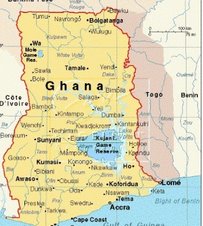
On Tuesday, we began a two day journey from Accra to the northern town of Bolgatanga. The van we have was packed very full with our luggage, our boxes of water (and wine), and people. The trip on the road from Accra was filled with many reasons for us to slow down including potholes, road works, and spped bumps. Because the power does not often function speed bumps are used on major roads to slow down the traffic. In the US, you usually hope to travel a mile per minute. Here you hope to travel a kilometer per minute. The infrastructure here is improving. In 1984, we were told that it took approximately 11 hours to travel the 140 kilometers from Tamale' to Bolgatnanga. On Thursday we made the trip in about two hours. On the the first day of the roadtrip, we stopped at the Silicon hotel near Kumasi. It was owned by a man from California who was dedicated to educating folks on the history of the US on civil rights. There were plaques on the wall dedicated to Sojourner Truth, Frederick Douglass, Harriet Tubman, Daisy Bates, and Malcolm X. It was really neat. The trip on wednesday from Kumasi to Tamale' was very long. It took us nearly ten hours, and when we arrived we had to wait because there was amix up on our reservations. The next day we toured an Islamic high school in the morning and preceded to Bolgatanga. The school was an interesting place, but they were in the middle of exams, so we only stayed for about an hour. I met the soccer coach who was very interesting (he has a brother in Atlanta), and we talked about coaching. I gave him two soccer balls, two pumps, and a handful of extra needles. Hopefully, the gift will help him when the new term begins.
We then travled to Bolgatanga, where we checked into the Comme Ci, Comme sa Hotel. It is appropriately named, but the cokes cost about 50 cents and the very large beers are slightly less than a dollar. Life could be a lot worse. We feel the rolling black-outs the country is experiencing, and we have to share a bed with our roomate. I haen't slept in the bed with another man since a soccer trip many years ago. It will be fine. We will be here until tuesday when we travel back to Tamle' and on to Kumasi.
Friday marked my favorite day of the trip so far. We had a potpourri of stops. Our fist stop was a place called the Pinkora Slave Camping Site, which was used byraiders to hold slaves until they had enough to transport them some 500 miles to the cost to the castles at Cape Coast and El Camina. We will visit both of those sites in a couple of weeks. The Pinkora Site was unfortunately a prime example of how humans can take full advantage of what nature provides. On the site there was a well that flowed up through the rocks so that captives could drink. The raiders fed the captives on the ground so thae captives scraped out bowls in the rock. It was very well-preserved. There was also a place where the captives would beat on the rocks with stones while singing songs about resisting the efforts of the raiders breaking their spirit. I nthe brochure the musis was referred to as "rock music". a group of local men played a few songs for us. It was enormously moving. We continued the tour of the facility which was about one square kilometer, and went to the watch post for the raiders. This spot was a location with about three very large rocks naturally stocked, which gave the raiders a good perspective from which to protect their interests. They were there to watch out for locals wishing to rescue their family members who had been captured, and to also thwart the effort of rival raiders looking for the "easy score." The area was subject to attack from three different ethnic groups. One was from present day Mali, one was from present day Burkina Faso, and one was from an area in Ghana that was off to the east. The final stop on the rougly one-hour tour was a spt where captives who were "stubborn" were beaten were often killed to serve as an example. It was truly a stop which will give me a much more complete understadning of a topic in which I have always felt very interested.
We then preced to the nearby Zenga Crocodlile Pond to a village where the crocidile is a totem animal. This means that the animal is sacred and can not be harmed. For a small fee the crocodile guys lured about three or four alligator cousins out of the pond. They then got one of them who was about 89 years old to sit still so we could either sit on its back or hold its by its tail. I held its buy its tail, and will post the picture of me on this blog when I can (which I am starting to believe won't be until I return home in late august. The crocodile was sacred because he led a warrior who was lost many years ago to water and safety. The warrior thanked the croc, and now it is believed that each family in town has a special crocodile dedicated to them. The crocodiles roam the village in the night and will not bother the goats and people of the area. When asked how he knew the crocodies age, the "trainer" said his grandfather lived here when the crocodile was born. It was a really cool story.
We then proceeded a little north and crossed the Burkina Faso border just so that we could say we went into Burkina Faso. I tried an ear of corn cooking on the open grills and a piece of goat meat. Neither is a dish that I am craving to try again, but it was fun to eat. All of the meat here is enormously spicy, and I am having reasonable success eacting the local cuisine. I find myself craving a steak from Garrison's and some soup from Thai Diner near my house. The most interesting part of crossing into Burkina was hearing how people who had historical ties for a very long time spoke English in Ghana and French in Burkina. You got a love that colonialism.
Next, we went to visit a place called the Association Development for People (ADEP). It was a essentially an NGO (like a non-profit organization) designed to grant local (women) farmers micro-credit loans. The average loan is about one new Ghanaian Cedi which is slightly more than a dollar. The group fed us which made me feel like I was stealing, but yo shold have seen the faces of the members when Max informed them that we would be leaving them 100 Ghanaian Cedis. I hink I have found an organization that Lovett can assist with funds to help ADEP provide loans to people who make very little per year. In this area, it is estimated that nine of ten people subsist below the poverty line which is earning about 7 Ghanaian Cedis a year. That equals about $7.50 a year. I will give this internet cafe' a bit more than that for being able to post this entry.
Today, we visited The Sirigu Women's Organization for Pottery and Arts (SWOPA) in the town of Sirigu. They have a website, but the guide did not know the web address. Google it if you wish; the guide said there were some pics and info. It was really fascinating. The whole time I was there I was thinking about how cool Tom Zwirlein would think this place was. The had little rooms that one could rent for about 7 G cedis a day. The place was provided electriciy by solar panels and is part of program that is called eco-tourism, which the slave camp and croc ponds are also a part. The tour guide showed us his own families living complexes. He showed where the millet (a grain) was stored and where the family made decisions led by the elder. There was an intersting story that I had added but due to Internet conncetion troubles that part didn't save. I'll suffice if for now to say the the royal python is a sacred animal here and lives in a portion of each person's home. By for now, check back soon. I am really digging this trip.
Tohajie is out!!!
In the last few days, we have done everything listed in the title of this blog entry. I will proceed in a matter of fact manner, and try to write more thoughtfully when I get a chance.
On Tuesday, we began a two day journey from Accra to the northern town of Bolgatanga. The van we have was packed very full with our luggage, our boxes of water (and wine), and people. The trip on the road from Accra was filled with many reasons for us to slow down including potholes, road works, and spped bumps. Because the power does not often function speed bumps are used on major roads to slow down the traffic. In the US, you usually hope to travel a mile per minute. Here you hope to travel a kilometer per minute. The infrastructure here is improving. In 1984, we were told that it took approximately 11 hours to travel the 140 kilometers from Tamale' to Bolgatnanga. On Thursday we made the trip in about two hours. On the the first day of the roadtrip, we stopped at the Silicon hotel near Kumasi. It was owned by a man from California who was dedicated to educating folks on the history of the US on civil rights. There were plaques on the wall dedicated to Sojourner Truth, Frederick Douglass, Harriet Tubman, Daisy Bates, and Malcolm X. It was really neat. The trip on wednesday from Kumasi to Tamale' was very long. It took us nearly ten hours, and when we arrived we had to wait because there was amix up on our reservations. The next day we toured an Islamic high school in the morning and preceded to Bolgatanga. The school was an interesting place, but they were in the middle of exams, so we only stayed for about an hour. I met the soccer coach who was very interesting (he has a brother in Atlanta), and we talked about coaching. I gave him two soccer balls, two pumps, and a handful of extra needles. Hopefully, the gift will help him when the new term begins.
We then travled to Bolgatanga, where we checked into the Comme Ci, Comme sa Hotel. It is appropriately named, but the cokes cost about 50 cents and the very large beers are slightly less than a dollar. Life could be a lot worse. We feel the rolling black-outs the country is experiencing, and we have to share a bed with our roomate. I haen't slept in the bed with another man since a soccer trip many years ago. It will be fine. We will be here until tuesday when we travel back to Tamle' and on to Kumasi.
Friday marked my favorite day of the trip so far. We had a potpourri of stops. Our fist stop was a place called the Pinkora Slave Camping Site, which was used byraiders to hold slaves until they had enough to transport them some 500 miles to the cost to the castles at Cape Coast and El Camina. We will visit both of those sites in a couple of weeks. The Pinkora Site was unfortunately a prime example of how humans can take full advantage of what nature provides. On the site there was a well that flowed up through the rocks so that captives could drink. The raiders fed the captives on the ground so thae captives scraped out bowls in the rock. It was very well-preserved. There was also a place where the captives would beat on the rocks with stones while singing songs about resisting the efforts of the raiders breaking their spirit. I nthe brochure the musis was referred to as "rock music". a group of local men played a few songs for us. It was enormously moving. We continued the tour of the facility which was about one square kilometer, and went to the watch post for the raiders. This spot was a location with about three very large rocks naturally stocked, which gave the raiders a good perspective from which to protect their interests. They were there to watch out for locals wishing to rescue their family members who had been captured, and to also thwart the effort of rival raiders looking for the "easy score." The area was subject to attack from three different ethnic groups. One was from present day Mali, one was from present day Burkina Faso, and one was from an area in Ghana that was off to the east. The final stop on the rougly one-hour tour was a spt where captives who were "stubborn" were beaten were often killed to serve as an example. It was truly a stop which will give me a much more complete understadning of a topic in which I have always felt very interested.
We then preced to the nearby Zenga Crocodlile Pond to a village where the crocidile is a totem animal. This means that the animal is sacred and can not be harmed. For a small fee the crocodile guys lured about three or four alligator cousins out of the pond. They then got one of them who was about 89 years old to sit still so we could either sit on its back or hold its by its tail. I held its buy its tail, and will post the picture of me on this blog when I can (which I am starting to believe won't be until I return home in late august. The crocodile was sacred because he led a warrior who was lost many years ago to water and safety. The warrior thanked the croc, and now it is believed that each family in town has a special crocodile dedicated to them. The crocodiles roam the village in the night and will not bother the goats and people of the area. When asked how he knew the crocodies age, the "trainer" said his grandfather lived here when the crocodile was born. It was a really cool story.
We then proceeded a little north and crossed the Burkina Faso border just so that we could say we went into Burkina Faso. I tried an ear of corn cooking on the open grills and a piece of goat meat. Neither is a dish that I am craving to try again, but it was fun to eat. All of the meat here is enormously spicy, and I am having reasonable success eacting the local cuisine. I find myself craving a steak from Garrison's and some soup from Thai Diner near my house. The most interesting part of crossing into Burkina was hearing how people who had historical ties for a very long time spoke English in Ghana and French in Burkina. You got a love that colonialism.
Next, we went to visit a place called the Association Development for People (ADEP). It was a essentially an NGO (like a non-profit organization) designed to grant local (women) farmers micro-credit loans. The average loan is about one new Ghanaian Cedi which is slightly more than a dollar. The group fed us which made me feel like I was stealing, but yo shold have seen the faces of the members when Max informed them that we would be leaving them 100 Ghanaian Cedis. I hink I have found an organization that Lovett can assist with funds to help ADEP provide loans to people who make very little per year. In this area, it is estimated that nine of ten people subsist below the poverty line which is earning about 7 Ghanaian Cedis a year. That equals about $7.50 a year. I will give this internet cafe' a bit more than that for being able to post this entry.
Today, we visited The Sirigu Women's Organization for Pottery and Arts (SWOPA) in the town of Sirigu. They have a website, but the guide did not know the web address. Google it if you wish; the guide said there were some pics and info. It was really fascinating. The whole time I was there I was thinking about how cool Tom Zwirlein would think this place was. The had little rooms that one could rent for about 7 G cedis a day. The place was provided electriciy by solar panels and is part of program that is called eco-tourism, which the slave camp and croc ponds are also a part. The tour guide showed us his own families living complexes. He showed where the millet (a grain) was stored and where the family made decisions led by the elder. There was an intersting story that I had added but due to Internet conncetion troubles that part didn't save. I'll suffice if for now to say the the royal python is a sacred animal here and lives in a portion of each person's home. By for now, check back soon. I am really digging this trip.
Tohajie is out!!!
Tuesday, July 17, 2007
Heading North
Greetings from Tohajie!!!
We are leaving Accra to head north to Kumasi for a night and then on to Tamale' and Bolgatanga. It will be roughly a 21 - day excursion until we return to Accra for our home stay. We are storing a big portion of our luggage, and trying to ravel as light as possible. I am trying to wash a little bit of my clothes each night. It is an experience that is very satisfying. It reminds me of pumping water on a backpacking trip.
I wanted to take some time out to reflect on our first ten days here in Ghana. We have been extraordinarily fortunate to hear from the very gifted professors along the way. Yesterday was no exception.
The first we lecturer was an expert on land uses in Urban areas of Ghana and how it is changing. The professor's name was Joseph Ayee, and he spoke about Urban sprawl in the Accra-Tema metropolitan region. The Accra area differs from Atlanta in that it has a bay that stops growth in the south, but it is similar to Atlanta in that there are not really any boundaries that stop it from spreading in any other direction. An urban area is defined in Ghana as an area that has a population of 5000 or more. A rural area is defined as one with 4999 and less. Around the time of independence in 1957 approximately 20% of Ghana was urban. By the 2000 census, the urban percentage had jumped up to over 44. The urban areas, Accra-Tema in particular, have received a disproportionate amount of money for its infrastructure. Seeing how most of the wealth that comes into Ghana is a product of gold, cocoa, and trees (all found in rural areas), the metropolitan areas have had more money allocated to its development than the income it brings in. The Accra-Tema area is a good area for investment however because of its proximity for land locked nations such as Burkina Faso, Niger, and Mali. Accra-Tema can serve as a port, so the development seems to me like a worthwhile investment.
It seems that land usage is the biggest problem that is hurting the growth of the greater Accra region. About 80% of the land is still distributed in the customary fashion, which I am sorry to say I do not understand so well as of yet. Here is what I understand so far. The chiefs and their subordinates dole out the land as they see fit. If they tell a farmer he can use it for five years and if a developer comes along and makes the land controller a better offer then the chief can make a new deal with the developer leaving the poorer farmer out of the loop. This of course creates a very desperate situation for farmers who fall in this category. The area around Accra is lined with a blend of commercial shops and small farms. It is unlike anything I have witnessed in the United States. It is a problem that is hindering Accra's development, but there are signs of growth. It was very interesting when Professor Ayee said that the youth all are desiring to own cars, so they can sit in the traffic jams of the city. Doesn't this have a familiar ring to it. It will be interesting to see how well Accra compares to other urban areas we will visit like Tamale, Kumasi, and Cape Coast.
It is also interesting to speculate how the need for debt relief (as we discussed last week) might help this developing nation handle its very modern day problem of urban sprawl.
I will change direction now because yesterday afternoon we were treated to a talk by Owuso Brembong who is an expert on the many festivals of Ghana. There are two national festivals (holidays) dedicated each year and there are two dedicated each year to Islam. There are also days of celebration for national holidays. A very special example of this would have been Ghana's 50th year of independence from the British on March 6th earlier this year. Now here is the interesting part. There are 68 different ethnic groups in Ghana that celebrate 174 different festivals a year that all have a different deity at its base level. Naturally these festivals do not receive a national holiday status, but the preparation and actual celebrations can last for two to three weeks, which does interfere with the amount of work that gets done in a certain region. We are going to attend Akwasidae Festival in Kumasi in a few weeks. In the Akwasidae Festival, people try to make connections to their ancestors (those who have died in this life).
Again I don't fully understand the traditional religions, but they go like this as far as I understand. The Ontology is that the Supreme Being is called Onyama and his offspring make up various other deities. Next in the pyramidal structure are the ancestors who exist in the after-life. Then there are humans who are then followed by natural objects like trees, seas, rivers and animals. It is not acceptable to use the bathroom int eh river because of one's respect for nature. A love for mother earth is at the heart of these traditional faiths. One of the reasons why Christiananity and Islam blended so well with the traditional religions is because the gods of these monotheistic faiths did not offend the structure of the traditional religion. After all, how can another god in one's corner be a bad thing.
An interesting celebration that Professor Brempong told us about was the one in his home village (near Kumasi) of Techiman. The festival is called Apo] ( the ] stands for a backward "c" in the Twi language - it has an o sound). It is a festival that originated because the chief's sons were mistreating the people. they were riding around on horses and throwing arrows at folks. Some of the people were killed. In protest, the people refused to work and even more people began to die. At the behest of the gods the chief created a time in which people could compose songs that in essence complained to the chief. The chief was not permitted to retaliate against the people and was supposed to atone for his actions. As the years passed by, the festival has become an 11 day affair where anyone can right songs and sing them about anyone that they have a problem with. It is a time of reconciliation and sounds like a very civilized way to handle differences between people.
So there you have it - my rudimentary understanding of Urban sprawl and festivals. I wonder if any of you reading this find it a fascinating as I do. Take care for now and I'll try to blog again when we get to Tamale'.
We are leaving Accra to head north to Kumasi for a night and then on to Tamale' and Bolgatanga. It will be roughly a 21 - day excursion until we return to Accra for our home stay. We are storing a big portion of our luggage, and trying to ravel as light as possible. I am trying to wash a little bit of my clothes each night. It is an experience that is very satisfying. It reminds me of pumping water on a backpacking trip.
I wanted to take some time out to reflect on our first ten days here in Ghana. We have been extraordinarily fortunate to hear from the very gifted professors along the way. Yesterday was no exception.
The first we lecturer was an expert on land uses in Urban areas of Ghana and how it is changing. The professor's name was Joseph Ayee, and he spoke about Urban sprawl in the Accra-Tema metropolitan region. The Accra area differs from Atlanta in that it has a bay that stops growth in the south, but it is similar to Atlanta in that there are not really any boundaries that stop it from spreading in any other direction. An urban area is defined in Ghana as an area that has a population of 5000 or more. A rural area is defined as one with 4999 and less. Around the time of independence in 1957 approximately 20% of Ghana was urban. By the 2000 census, the urban percentage had jumped up to over 44. The urban areas, Accra-Tema in particular, have received a disproportionate amount of money for its infrastructure. Seeing how most of the wealth that comes into Ghana is a product of gold, cocoa, and trees (all found in rural areas), the metropolitan areas have had more money allocated to its development than the income it brings in. The Accra-Tema area is a good area for investment however because of its proximity for land locked nations such as Burkina Faso, Niger, and Mali. Accra-Tema can serve as a port, so the development seems to me like a worthwhile investment.
It seems that land usage is the biggest problem that is hurting the growth of the greater Accra region. About 80% of the land is still distributed in the customary fashion, which I am sorry to say I do not understand so well as of yet. Here is what I understand so far. The chiefs and their subordinates dole out the land as they see fit. If they tell a farmer he can use it for five years and if a developer comes along and makes the land controller a better offer then the chief can make a new deal with the developer leaving the poorer farmer out of the loop. This of course creates a very desperate situation for farmers who fall in this category. The area around Accra is lined with a blend of commercial shops and small farms. It is unlike anything I have witnessed in the United States. It is a problem that is hindering Accra's development, but there are signs of growth. It was very interesting when Professor Ayee said that the youth all are desiring to own cars, so they can sit in the traffic jams of the city. Doesn't this have a familiar ring to it. It will be interesting to see how well Accra compares to other urban areas we will visit like Tamale, Kumasi, and Cape Coast.
It is also interesting to speculate how the need for debt relief (as we discussed last week) might help this developing nation handle its very modern day problem of urban sprawl.
I will change direction now because yesterday afternoon we were treated to a talk by Owuso Brembong who is an expert on the many festivals of Ghana. There are two national festivals (holidays) dedicated each year and there are two dedicated each year to Islam. There are also days of celebration for national holidays. A very special example of this would have been Ghana's 50th year of independence from the British on March 6th earlier this year. Now here is the interesting part. There are 68 different ethnic groups in Ghana that celebrate 174 different festivals a year that all have a different deity at its base level. Naturally these festivals do not receive a national holiday status, but the preparation and actual celebrations can last for two to three weeks, which does interfere with the amount of work that gets done in a certain region. We are going to attend Akwasidae Festival in Kumasi in a few weeks. In the Akwasidae Festival, people try to make connections to their ancestors (those who have died in this life).
Again I don't fully understand the traditional religions, but they go like this as far as I understand. The Ontology is that the Supreme Being is called Onyama and his offspring make up various other deities. Next in the pyramidal structure are the ancestors who exist in the after-life. Then there are humans who are then followed by natural objects like trees, seas, rivers and animals. It is not acceptable to use the bathroom int eh river because of one's respect for nature. A love for mother earth is at the heart of these traditional faiths. One of the reasons why Christiananity and Islam blended so well with the traditional religions is because the gods of these monotheistic faiths did not offend the structure of the traditional religion. After all, how can another god in one's corner be a bad thing.
An interesting celebration that Professor Brempong told us about was the one in his home village (near Kumasi) of Techiman. The festival is called Apo] ( the ] stands for a backward "c" in the Twi language - it has an o sound). It is a festival that originated because the chief's sons were mistreating the people. they were riding around on horses and throwing arrows at folks. Some of the people were killed. In protest, the people refused to work and even more people began to die. At the behest of the gods the chief created a time in which people could compose songs that in essence complained to the chief. The chief was not permitted to retaliate against the people and was supposed to atone for his actions. As the years passed by, the festival has become an 11 day affair where anyone can right songs and sing them about anyone that they have a problem with. It is a time of reconciliation and sounds like a very civilized way to handle differences between people.
So there you have it - my rudimentary understanding of Urban sprawl and festivals. I wonder if any of you reading this find it a fascinating as I do. Take care for now and I'll try to blog again when we get to Tamale'.
Sunday, July 15, 2007
The Dam and the Beach
First of all for those of you who are commenting on my blog entries, Thank you. I am trying to respond to any requests you have among the comments, so please look there to see if I have commented.
On Saturday and Sunday (yesterday and today) we visited the Akosombo Dam and the beach at the Com Si Resort. they were play days, but there were at least two valuable lessons that I learned.
At the Akosombo Dam, which is about a 90 minute drive from Accra, we joined two other groups to hear about and see the facility. It is a dam that was constructed in the early 1960's to help Ghana modernize in its push for electricity. It is a massive dam, and it blocks the red, white, and black parts of the Volta River. The damming created Lake Volta, which is the largest man-made lake in the world. On top of providing power to Ghana, the plant also sends electricity to neighboring Togo on the east and Cote D'Ivoire on the west.
One of the two other groups were a group of elementary-aged students, so the tour guide (who worked for the power company) talked at their level (his words). I was impressed because he was able to explain to the students and the adults all about how the dam functions. But I was also impressed because he was speaking about the importance of conservation at such a desperate time for Ghana. The intake tank is not supposed to go lower than 235 meters and it is dangerously close to there now. Ghana has been on rolling blackouts since last December and if they do not get their expected rains in the north during the months of September and October their power and water situation could become critical and maybe even severe. I thought it was interesting how the guide (who spoke as if he were an engineer) told the group of students how they could do their part.
By the way, I have figure out a way to download picture, but the Internet connection is slow and I have not yet had the patience to let a picture download. The Internet connection here costs about $5 an hour, so I will try another Internet Cafe' during our travels, so stay tuned.
Today, we were scheduled to go to the beach, but the one we planned to visit was closed due to the fact that it was heavily polluted. We drove east from Accra toward the area around Tema. We found one beach, but we couldn't get the bus down the road to discover whether or not it was suitable. We then found the Com Si Resort and even though the water was washing trash and debris on the shore, we decided to stay there. The area was very nice (except for the pollution). We had a shaded area in which to sit that was covered by coconut trees. There were two gigantic speakers banging out some reggae tunes, and a space on the beach large enough to play a 5 v. 5 football match. I joined our guides and their friends to play against 5 local boys. We hammered boards in the ground to make goal posts and away we went. My team had six players with one sub. Our team consisted of Ben, Daniel, Renel, Theo, Razak, and I. We won 5-0. Razak scored twice while Renel, Ben, and Daniel all scored once. Theo said he set up all the goals. I enjoyed myself thoroughly, and I am now considering retiring on the continent, so I can say I am undefeated in Africa. The truth is I don't think I did so badly. I won a few tackles and made some useful passes. I have never played in beach sand quite so thick. The sand in Daytona was always compacted due to the cars. After playing we drank a ceremonial victory beverage and grooved to the beat of the music. and then we went to a late lunch at a fast food joint called Southern Fried Chicken Express.
Not only did this place have fired chicken, but they had burgers, hot dogs, pizzas, Indian food, Lebanese food, fish, and Ghanaian food. There was a birthday party going on at the tables just down form ours and I helped a family out by taking a picture of all of them in it at one time. About the only difference between this place and a place off the highway in the United States was that here there was a bunch of cattle grazing in the open field on the other side of the road. It was fun.
Tomorrow we will work on our projects and prepare to drive to Kumasi and on to Tamale'. Keep checking and keep responding.
Tohajie is out for now.
On Saturday and Sunday (yesterday and today) we visited the Akosombo Dam and the beach at the Com Si Resort. they were play days, but there were at least two valuable lessons that I learned.
At the Akosombo Dam, which is about a 90 minute drive from Accra, we joined two other groups to hear about and see the facility. It is a dam that was constructed in the early 1960's to help Ghana modernize in its push for electricity. It is a massive dam, and it blocks the red, white, and black parts of the Volta River. The damming created Lake Volta, which is the largest man-made lake in the world. On top of providing power to Ghana, the plant also sends electricity to neighboring Togo on the east and Cote D'Ivoire on the west.
One of the two other groups were a group of elementary-aged students, so the tour guide (who worked for the power company) talked at their level (his words). I was impressed because he was able to explain to the students and the adults all about how the dam functions. But I was also impressed because he was speaking about the importance of conservation at such a desperate time for Ghana. The intake tank is not supposed to go lower than 235 meters and it is dangerously close to there now. Ghana has been on rolling blackouts since last December and if they do not get their expected rains in the north during the months of September and October their power and water situation could become critical and maybe even severe. I thought it was interesting how the guide (who spoke as if he were an engineer) told the group of students how they could do their part.
By the way, I have figure out a way to download picture, but the Internet connection is slow and I have not yet had the patience to let a picture download. The Internet connection here costs about $5 an hour, so I will try another Internet Cafe' during our travels, so stay tuned.
Today, we were scheduled to go to the beach, but the one we planned to visit was closed due to the fact that it was heavily polluted. We drove east from Accra toward the area around Tema. We found one beach, but we couldn't get the bus down the road to discover whether or not it was suitable. We then found the Com Si Resort and even though the water was washing trash and debris on the shore, we decided to stay there. The area was very nice (except for the pollution). We had a shaded area in which to sit that was covered by coconut trees. There were two gigantic speakers banging out some reggae tunes, and a space on the beach large enough to play a 5 v. 5 football match. I joined our guides and their friends to play against 5 local boys. We hammered boards in the ground to make goal posts and away we went. My team had six players with one sub. Our team consisted of Ben, Daniel, Renel, Theo, Razak, and I. We won 5-0. Razak scored twice while Renel, Ben, and Daniel all scored once. Theo said he set up all the goals. I enjoyed myself thoroughly, and I am now considering retiring on the continent, so I can say I am undefeated in Africa. The truth is I don't think I did so badly. I won a few tackles and made some useful passes. I have never played in beach sand quite so thick. The sand in Daytona was always compacted due to the cars. After playing we drank a ceremonial victory beverage and grooved to the beat of the music. and then we went to a late lunch at a fast food joint called Southern Fried Chicken Express.
Not only did this place have fired chicken, but they had burgers, hot dogs, pizzas, Indian food, Lebanese food, fish, and Ghanaian food. There was a birthday party going on at the tables just down form ours and I helped a family out by taking a picture of all of them in it at one time. About the only difference between this place and a place off the highway in the United States was that here there was a bunch of cattle grazing in the open field on the other side of the road. It was fun.
Tomorrow we will work on our projects and prepare to drive to Kumasi and on to Tamale'. Keep checking and keep responding.
Tohajie is out for now.
Friday, July 13, 2007
The Presbyterian Secondary School
The Presbyterian Secondary School (Presec) is located in a subdivision outside of Accra.As an American I automatically assumed that the Presbyterian Secondary School would be a private school. I was wrong though as I discovered that many public schools in Ghana were started by missionaries and the government just kept the same names when they took over the educational system. Presec is a school which focuses primarily on the sciences, but they do have a curriculum which covers four of the basics: Science, Mathematics, English, and Social Studies. Exams for the students have actually already begun, but a few of the teachers allowed us to come in as they conducted reviews and preparations for finals.Andy joined me at the school visit and we were placed in the capable hands of the history teacher, Yaw Oti-Dankese. In the Ghanaian school system, a secondary student attends for three years although that is increasing to four beginning with next years form 1 (freshmen) students. Mr. Dankese teaches all of the history classes at his school. In the first year the focus on 10 main issues in ancient history. In the second year, the focus moves to pre-colonial Africa. Finally, in the third year the students discuss Ghana since colonialism. It is important to note that all three years focus virtually entirely upon Africa with the last two years dedicated almost exclusively to Ghana. This is of course not completely possible since it was the colonial boundaries that created the borders of the African nations today.
I was a little disappointed that I did not get to have a lot of time to discuss information with students, but it is very understandable given what time in the school year it is. On the first day, a saw an English teacher review about various figures of speech including metaphors, similes, and personification. The students were pretty well engaged and seemed to understand, which is a good sign since it was review.Mr. Dankese reviewed Ancient Egypt to his form one class. It was a good review, but the information was not at all new to me, so I was hoping for something better. We then met a physics teacher named Alex Yalley. We then met Mr. Yalley's class. He was going over the last quiz of the term; he had 41 students in his class. (Speaking of class size, when we returned to the boss and boarded the shuttle bus which had dropped each of us at different schools, it was interesting to hear that some of our colleagues visited classrooms with over 70 students. Mr. Dankese told Andy and me that a starting teacher makes a small fraction in salary a year. These last two facts make me appreciate my job more so than I already do.) When Mr. Yalley gave the students their quizzes back, he gave them out publicly and in order from first to worst (in performance). Initially, it seemed demeaning. In fact, I could only imagine what would happen to me if returned quizzes in such a fashion. However, it turned out that the school is enormously competitive, and the kids seemed to be genuinely interested in how they fared up against their mates. Mr. Yalley also called out the scores, but after the scores dipped below an 85, he no longer called out their marks as he called them. Andy noted that his method seemed cruel to us, but one could tell by the way the students responded to him that he cared about their progress very much. Mr. Yalley was also in charge of the computer lab, which has been "down" for two years because their server was broken. I will revisit Mr. Yalley later in this entry.
On our second day, Mr. Dankese's class began @ 7:20 AM, so Andy and I decided that we would hire a cab instead of waiting for our bus. Frances, one of our guides who pamper us, went and negotiated our fare for us. Andy and I took a ten minute cab ride for approximately $2.20. It is kind of fun here how negotiating for prices for nearly everything here is part of the culture. Andy and I gave the driver a little extra for being so nice to us. Anyway, Andy and I arrived at Presec at about 7:15. Mr. Dankese was a little late, but one of his students came to where we were waiting and invited us in. When he arrived Mr. Dankese, decided to review for his form 2 class about an area in the northern part of present day Ghana. (Later we found out that he only conducted the review for us, because the students had already begun finals and the standard was to use class time to let the students study for their next test.) This is just one example of how nice the people of Ghana are. Anyway, the review was tremendous and I learned about a subject that I knew almost nothing about. I also acquired a self-imposed nickname. Mr. Dankese told us about a king who was named Tohajie (the Red Hunter). He had a fair complexion and was a warrior, and he led his people from the Lake Chad region into Zamfara in present day Nigeria. The group of people continued to migrate until they wound up conquering what is part of northern (PRESENT DAY) Ghana. After the lecture, we set up an appointment with Mr. Yalley because he and Mr. Dankese are key contact people in what my ever-changing curriculum proposal will be.
With help from Garry Hill, I had this vision of helping to facilitate some micro-credit loans of entrepreneurs in the surrounding community of a Ghanaian school. But after visiting Presec, which is considered one of the best schools in Ghana, I discovered that their server for Internet access had failed to work for nearly two years. Mr. Yalley is in charge of the school's computer lab. I also wanted to establish communication links with a history class here in Ghana. So I discussed with Mr. Yalley and Mr. Dankese the possibility of providing some resources to help them get their computer lab up and running again, so that my class and Mr. Dankese's class can set up a blog where each class can set up a way to discuss the respective presidential elections in 2008. President Kuofor is leaving office after serving two four year terms, as is President Bush. Oodles of individuals are in the process of seeking their parties' nod to be the main candidate. Compared to Ghana, this is "old hack" for the US, while Ghana has never really experienced a peaceful transition of civilian power to the fullest extent. Both elections are receiving tons of media attention, and Mr. Dankese and I agree that it would be interested to half the students correspond with each other over the coming months. So, any of you that have ideas please think about them, so that we can discuss in full this proposal. I have made no promises to Mr. Yalley and Mr. Dankese, but I would be thrilled if we could assist in getting them up and running. Please think of ways the Lovett community can assist. Presec is a college prep school like Lovett, only their infrastructure is poor in comparison to ours. It would be exciting to help make this happen. In the Twi language I say to all of you, Medasse' Pa, which means thank you very much. Please think of ways to help Tohajie be a red warrior for the sake of modern education. Thank you and may all of you be blessed. I'll write again soon, but we leave the Accra area on Tuesday and I do not know what my Internet access will be like. Nante Yie!!!
I was a little disappointed that I did not get to have a lot of time to discuss information with students, but it is very understandable given what time in the school year it is. On the first day, a saw an English teacher review about various figures of speech including metaphors, similes, and personification. The students were pretty well engaged and seemed to understand, which is a good sign since it was review.Mr. Dankese reviewed Ancient Egypt to his form one class. It was a good review, but the information was not at all new to me, so I was hoping for something better. We then met a physics teacher named Alex Yalley. We then met Mr. Yalley's class. He was going over the last quiz of the term; he had 41 students in his class. (Speaking of class size, when we returned to the boss and boarded the shuttle bus which had dropped each of us at different schools, it was interesting to hear that some of our colleagues visited classrooms with over 70 students. Mr. Dankese told Andy and me that a starting teacher makes a small fraction in salary a year. These last two facts make me appreciate my job more so than I already do.) When Mr. Yalley gave the students their quizzes back, he gave them out publicly and in order from first to worst (in performance). Initially, it seemed demeaning. In fact, I could only imagine what would happen to me if returned quizzes in such a fashion. However, it turned out that the school is enormously competitive, and the kids seemed to be genuinely interested in how they fared up against their mates. Mr. Yalley also called out the scores, but after the scores dipped below an 85, he no longer called out their marks as he called them. Andy noted that his method seemed cruel to us, but one could tell by the way the students responded to him that he cared about their progress very much. Mr. Yalley was also in charge of the computer lab, which has been "down" for two years because their server was broken. I will revisit Mr. Yalley later in this entry.
On our second day, Mr. Dankese's class began @ 7:20 AM, so Andy and I decided that we would hire a cab instead of waiting for our bus. Frances, one of our guides who pamper us, went and negotiated our fare for us. Andy and I took a ten minute cab ride for approximately $2.20. It is kind of fun here how negotiating for prices for nearly everything here is part of the culture. Andy and I gave the driver a little extra for being so nice to us. Anyway, Andy and I arrived at Presec at about 7:15. Mr. Dankese was a little late, but one of his students came to where we were waiting and invited us in. When he arrived Mr. Dankese, decided to review for his form 2 class about an area in the northern part of present day Ghana. (Later we found out that he only conducted the review for us, because the students had already begun finals and the standard was to use class time to let the students study for their next test.) This is just one example of how nice the people of Ghana are. Anyway, the review was tremendous and I learned about a subject that I knew almost nothing about. I also acquired a self-imposed nickname. Mr. Dankese told us about a king who was named Tohajie (the Red Hunter). He had a fair complexion and was a warrior, and he led his people from the Lake Chad region into Zamfara in present day Nigeria. The group of people continued to migrate until they wound up conquering what is part of northern (PRESENT DAY) Ghana. After the lecture, we set up an appointment with Mr. Yalley because he and Mr. Dankese are key contact people in what my ever-changing curriculum proposal will be.
With help from Garry Hill, I had this vision of helping to facilitate some micro-credit loans of entrepreneurs in the surrounding community of a Ghanaian school. But after visiting Presec, which is considered one of the best schools in Ghana, I discovered that their server for Internet access had failed to work for nearly two years. Mr. Yalley is in charge of the school's computer lab. I also wanted to establish communication links with a history class here in Ghana. So I discussed with Mr. Yalley and Mr. Dankese the possibility of providing some resources to help them get their computer lab up and running again, so that my class and Mr. Dankese's class can set up a blog where each class can set up a way to discuss the respective presidential elections in 2008. President Kuofor is leaving office after serving two four year terms, as is President Bush. Oodles of individuals are in the process of seeking their parties' nod to be the main candidate. Compared to Ghana, this is "old hack" for the US, while Ghana has never really experienced a peaceful transition of civilian power to the fullest extent. Both elections are receiving tons of media attention, and Mr. Dankese and I agree that it would be interested to half the students correspond with each other over the coming months. So, any of you that have ideas please think about them, so that we can discuss in full this proposal. I have made no promises to Mr. Yalley and Mr. Dankese, but I would be thrilled if we could assist in getting them up and running. Please think of ways the Lovett community can assist. Presec is a college prep school like Lovett, only their infrastructure is poor in comparison to ours. It would be exciting to help make this happen. In the Twi language I say to all of you, Medasse' Pa, which means thank you very much. Please think of ways to help Tohajie be a red warrior for the sake of modern education. Thank you and may all of you be blessed. I'll write again soon, but we leave the Accra area on Tuesday and I do not know what my Internet access will be like. Nante Yie!!!
Wednesday, July 11, 2007
The US Embassy, shopping, a day of lectures, and some dancing
Thanks to all of you for responding to my blog. I had another Proverb ready, but left it in my room. I would go back and get it, but there is a long line for the two computers that are working. I didn't want to give up my spot. I'll bring some more proverbs later. I have a bit of bad news and good news about pictures. The digital camera I brought is broken as far as I know, but the good news is that the rest of the group with whom I am traveling are taking a lot of pictures, so I will eventually be able to download some of them on to the blog.
Yesterday we traveled for our visit to the US Embassy in downtown Accra. The building was like a fortress, and it cost $112 million to build. It actually looked a lot like the Dekalb County Jail, which is next to I - 285 on Memorial Drive (in Atlanta). We were visited by two men, Ben and Chris. I would give you there last names, but we were instructed to leave our backpacks in the bus, so I didn't have anything on which to write their names. Ben was Ghanaian with a PhD. in one of the sciences (I think electrical engineering) who attended Auburn University. After working for 12 years in Alabama, I guess he decided to return home. Ben's job at the US Embassy is to help Ghanaian students figure out which college would be best for them to attend, and then to help them obtain Visas if they are going to attend a college in the United States. Ben was very candid with us and told us that Ghana's educational system is becoming more and more expensive each year. Hence, Ghanaians are required to pay more and more for their children's education. Ben outlined what he believed to be the two biggest problems facing the educational system in Ghana. The first was that not enough resources are being used to further develop research. It seems that value addition is needed for their resources, and greater technology is needed to improve what they have in abundance. The three biggest exports from Ghana are gold, cacao, and timber. The second problem, as well as the first, is one that Ghana shares with many African nations. How do they stop the brain drain that is occurring. In other words, how does the nation of Ghana get students educated abroad to return home. The second person to greet us was a young American (around 30 -35, I would guess) who was a career diplomat. His last assignment was Fiji and now he is in Ghana. He gave us what seemed to be the state department spiel about Ghana, and then kind of dodged, I mean answered a few questions. All and all it was a pretty neat visit. It is the first time I have ever been to an Embassy of any kind.
On the way to the embassy, we were stuck in some major traffic. It took us approximately 45 minutes to cover about six miles from our hotel to the Embassy. It was an entertaining ride especially when Francis (one of our guides) and Seth (our bus driver) were debating whether or not corrupt politics was at play when President Kuofor's son recently was able to purchase a partially built hotel from an established businessman of fifty years (who could not obtain a loan to finish construction), and then obtain the necessary funds to finish the hotel. By the way, the hotel just so happens to be located very near the President's home. Good governance and how to rid itself of corruption is a challenge for Ghana as it is for many other nations.
We then went and exchanged some money so that we could shop for fabric to have either a dress or shirt made. Before Max would let us take any money with us, he took us to a relatively small market, where we were bombarded with sales pitches of all kinds. The little market resembled a closed in open-air market with plenty of stalls of products to buy. My favorite salesman was a man named Brown who delighted in telling me the story of the Sankofa bird as he tried to sell me a sculpted piece. The idea of Sankofa relates to the idea that one can always go back and fix mistakes of the past. The carving is that of a bird with a long beak that is pruning his own back. Brown was charming, warm and of course eager to sell me something. Our conversation ended with him saying,"you name the price, and the product and I will let you have it for that price." We were under strict orders from Max so I bade Brown farewell. If we get back to that spot, I will go and buy something from him. My least favorite seller was a young man, a hawker (a hawker is someone who aggressively tries to self you something without having a booth), who tried to lure me away to "see the beach." Our guides told me afterwards that he would have perhaps try to steal from me. There was never even one consideration of joining him (Thanks to Max). After our little splash in the market, we traveled to Makola Market where our primary goal was to find material for women's dresses, and men's shirts. I picked a material that has Ghana's commemorative fifty year celebration featured. A women named Jocelyn will be taking measurements and sewing the dresses for the women while we will have a tailor, Solomon, make the shirts for us boys. We will where these garments in Kumasi when we meet the Asantahene. Shopping was interesting, but the poverty made me quite sad. The good news is that it didn't seem to have that big of an impact on the Ghanaians walking around nor did it seem to inhibit the efforts of the sellers. One seller even said to me "Wie gehts" to me hoping that I was a German. The competition for sales is quite fierce, but the people are very good- natured about the process. It is considered a slight insult if one does not haggle for a lower price. Actually, bargaining is considered a form of socialization. I've enjoyed it so far.
Today (Wednesday), we attended two lectures at the University of Ghana. The first was by D. K. Tweretu on the political economy of Africa and the debt crisis. The second was by Ohene Konadu on traditional Ghanaian social institutions.
Professor Tweretu presented the problem that many African nations face concerning the amount of money they owe to the World Bank, The International Monetary Fund (IMF), and to individual nations. His lecture moved extraordinarily fast, and it was difficult to get down all of the details, but I think I understood the gist of what he was saying. Here is my interpretation. African nations, including Ghana, began borrowing a lot of money in the late 1950's and early 1960's when they obtained their independence from their European Colonial masters. The problem with the loans was that no one involved seemed to take into account to what extent the loans were actually needed or the ability of the borrowing nations to pay them back. This initial problem form the outset coupled with the misgoverning of many African nations only plummeted the borrowers into deeper debt. The debt has only grown to the point that statistically, each African infant born today has owes $482 at birth. Of course this number continues to grow, and despite international efforts at implementing debt relief programs, African nations, like Ghana, are slipping even further into to trouble. The problem of bringing about a resolution seems to hinge on the fact that creditors can not let go of what is owed them while African nations are struggling to implement any kind of program that can send them on a disciplined path of recovery. To me it seems like a vicious circle. Africans need to work on ways to add value to their natural resources and it seems to me that investors should quit taking advantage of the situation. I do understand that my version of events are a simplification of all that is going on, but I think my account is fairly close. African nations need to be more responsive to their won needs, while the people in positions of advantage need to have more compassion and finally help African nations to develop, not just take their resources.
The second talk of the day had to do with the institutions of family and marriage in traditional Akan society. The extended family is very real. According to an Ewe (the Ewe are a group of people who also inhabit present day Ghana) proverb, the extended family relationship is not like friendship that you can break at any time. There is a consistent support system for all members of the extended family, which includes what we would call in the US the Aunts, Uncles, and cousins. Only in Akan society, there are not really any aunts. My mother's sister is a mother figure who is responsible for taking over if my mother should die. My father's sister is a feminine father figure. In fact the closest thing to an aunt or an uncle would be my mother's brother, who is required (as are all adults) to be an integral part of the child's upbringing. To me the most impressive part of Ghanaian society is the concept of extended family. In the US, a challenge that our society is facing is what to we do with our elderly. The traditional Akan system addressed that because the extended family has always taken care of the elderly. In the US, we have a growing number of extended care facilities for the elderly, but in Ghana (with all its developmental challenges), this is still not a problem. Professor Konadu believes this to be one of Ghana's greatest achievements. I find it difficult to dispute.
Please forgive me for writing in such a hurry tonight. I have not taken time to write with great care. Tomorrow is our first day in which we will be visiting classrooms. I am as nervous as if it were the first day of school. Like always, I wonder if the students will be motivated by me, and I wonder what I will have to offer? I will try to let you know how it went within the next couple of days. Peace out, got nothing but love for you (that was for my friend Miles - I banged my chest twice and extended a peace sign).
Yesterday we traveled for our visit to the US Embassy in downtown Accra. The building was like a fortress, and it cost $112 million to build. It actually looked a lot like the Dekalb County Jail, which is next to I - 285 on Memorial Drive (in Atlanta). We were visited by two men, Ben and Chris. I would give you there last names, but we were instructed to leave our backpacks in the bus, so I didn't have anything on which to write their names. Ben was Ghanaian with a PhD. in one of the sciences (I think electrical engineering) who attended Auburn University. After working for 12 years in Alabama, I guess he decided to return home. Ben's job at the US Embassy is to help Ghanaian students figure out which college would be best for them to attend, and then to help them obtain Visas if they are going to attend a college in the United States. Ben was very candid with us and told us that Ghana's educational system is becoming more and more expensive each year. Hence, Ghanaians are required to pay more and more for their children's education. Ben outlined what he believed to be the two biggest problems facing the educational system in Ghana. The first was that not enough resources are being used to further develop research. It seems that value addition is needed for their resources, and greater technology is needed to improve what they have in abundance. The three biggest exports from Ghana are gold, cacao, and timber. The second problem, as well as the first, is one that Ghana shares with many African nations. How do they stop the brain drain that is occurring. In other words, how does the nation of Ghana get students educated abroad to return home. The second person to greet us was a young American (around 30 -35, I would guess) who was a career diplomat. His last assignment was Fiji and now he is in Ghana. He gave us what seemed to be the state department spiel about Ghana, and then kind of dodged, I mean answered a few questions. All and all it was a pretty neat visit. It is the first time I have ever been to an Embassy of any kind.
On the way to the embassy, we were stuck in some major traffic. It took us approximately 45 minutes to cover about six miles from our hotel to the Embassy. It was an entertaining ride especially when Francis (one of our guides) and Seth (our bus driver) were debating whether or not corrupt politics was at play when President Kuofor's son recently was able to purchase a partially built hotel from an established businessman of fifty years (who could not obtain a loan to finish construction), and then obtain the necessary funds to finish the hotel. By the way, the hotel just so happens to be located very near the President's home. Good governance and how to rid itself of corruption is a challenge for Ghana as it is for many other nations.
We then went and exchanged some money so that we could shop for fabric to have either a dress or shirt made. Before Max would let us take any money with us, he took us to a relatively small market, where we were bombarded with sales pitches of all kinds. The little market resembled a closed in open-air market with plenty of stalls of products to buy. My favorite salesman was a man named Brown who delighted in telling me the story of the Sankofa bird as he tried to sell me a sculpted piece. The idea of Sankofa relates to the idea that one can always go back and fix mistakes of the past. The carving is that of a bird with a long beak that is pruning his own back. Brown was charming, warm and of course eager to sell me something. Our conversation ended with him saying,"you name the price, and the product and I will let you have it for that price." We were under strict orders from Max so I bade Brown farewell. If we get back to that spot, I will go and buy something from him. My least favorite seller was a young man, a hawker (a hawker is someone who aggressively tries to self you something without having a booth), who tried to lure me away to "see the beach." Our guides told me afterwards that he would have perhaps try to steal from me. There was never even one consideration of joining him (Thanks to Max). After our little splash in the market, we traveled to Makola Market where our primary goal was to find material for women's dresses, and men's shirts. I picked a material that has Ghana's commemorative fifty year celebration featured. A women named Jocelyn will be taking measurements and sewing the dresses for the women while we will have a tailor, Solomon, make the shirts for us boys. We will where these garments in Kumasi when we meet the Asantahene. Shopping was interesting, but the poverty made me quite sad. The good news is that it didn't seem to have that big of an impact on the Ghanaians walking around nor did it seem to inhibit the efforts of the sellers. One seller even said to me "Wie gehts" to me hoping that I was a German. The competition for sales is quite fierce, but the people are very good- natured about the process. It is considered a slight insult if one does not haggle for a lower price. Actually, bargaining is considered a form of socialization. I've enjoyed it so far.
Today (Wednesday), we attended two lectures at the University of Ghana. The first was by D. K. Tweretu on the political economy of Africa and the debt crisis. The second was by Ohene Konadu on traditional Ghanaian social institutions.
Professor Tweretu presented the problem that many African nations face concerning the amount of money they owe to the World Bank, The International Monetary Fund (IMF), and to individual nations. His lecture moved extraordinarily fast, and it was difficult to get down all of the details, but I think I understood the gist of what he was saying. Here is my interpretation. African nations, including Ghana, began borrowing a lot of money in the late 1950's and early 1960's when they obtained their independence from their European Colonial masters. The problem with the loans was that no one involved seemed to take into account to what extent the loans were actually needed or the ability of the borrowing nations to pay them back. This initial problem form the outset coupled with the misgoverning of many African nations only plummeted the borrowers into deeper debt. The debt has only grown to the point that statistically, each African infant born today has owes $482 at birth. Of course this number continues to grow, and despite international efforts at implementing debt relief programs, African nations, like Ghana, are slipping even further into to trouble. The problem of bringing about a resolution seems to hinge on the fact that creditors can not let go of what is owed them while African nations are struggling to implement any kind of program that can send them on a disciplined path of recovery. To me it seems like a vicious circle. Africans need to work on ways to add value to their natural resources and it seems to me that investors should quit taking advantage of the situation. I do understand that my version of events are a simplification of all that is going on, but I think my account is fairly close. African nations need to be more responsive to their won needs, while the people in positions of advantage need to have more compassion and finally help African nations to develop, not just take their resources.
The second talk of the day had to do with the institutions of family and marriage in traditional Akan society. The extended family is very real. According to an Ewe (the Ewe are a group of people who also inhabit present day Ghana) proverb, the extended family relationship is not like friendship that you can break at any time. There is a consistent support system for all members of the extended family, which includes what we would call in the US the Aunts, Uncles, and cousins. Only in Akan society, there are not really any aunts. My mother's sister is a mother figure who is responsible for taking over if my mother should die. My father's sister is a feminine father figure. In fact the closest thing to an aunt or an uncle would be my mother's brother, who is required (as are all adults) to be an integral part of the child's upbringing. To me the most impressive part of Ghanaian society is the concept of extended family. In the US, a challenge that our society is facing is what to we do with our elderly. The traditional Akan system addressed that because the extended family has always taken care of the elderly. In the US, we have a growing number of extended care facilities for the elderly, but in Ghana (with all its developmental challenges), this is still not a problem. Professor Konadu believes this to be one of Ghana's greatest achievements. I find it difficult to dispute.
Please forgive me for writing in such a hurry tonight. I have not taken time to write with great care. Tomorrow is our first day in which we will be visiting classrooms. I am as nervous as if it were the first day of school. Like always, I wonder if the students will be motivated by me, and I wonder what I will have to offer? I will try to let you know how it went within the next couple of days. Peace out, got nothing but love for you (that was for my friend Miles - I banged my chest twice and extended a peace sign).
Monday, July 9, 2007
Arrival in Accra
The following interpretation of this proverb comes from Emmanuel K. A. Asante's Akan Proverbs: Their Origins, Meanings, and Symbolical Representation in Ghanaian Material Cultural Heritage. It was published by Asemba Publishers, Christian Council of Ghana in Accra in 2002. I purchased this piece of literature at the bookstore at the University of Ghana @ Legon.
An Akan proverb goes like this: "Woforo dua pa a, na wopia wo."
Its literal meaning is, "It is when you climb a good tree that you are pushed up."
There is a forest tree in Akan called the Pambewuo. It is a tree that has many branches, which causes children to want to climb it. When a child attempts to climb a pambewuo an elder will shout to discourage the child. The truth is that this type of tree is very brittle and loaded with thorns making it unsafe to climb. In the forest, there are many sturdy trees to climb. If an adult sees a child attempting to climb such a tree, then he or she will encourage the child. Thus, there are Akan wood-carvings, which show a man helping a boy climb a (good) tree.
I think this is a good time to discuss this particular proverb because of where we are in our trip. We arrived yesterday morning, and so far we have done very little as far as organized activity goes. Other than eating a few meals and resting, our our only formal destination (until tonight) has been a bus tour of the University of Ghana @ Legon located just outside of Accra. Many of the participants (me included) are "chomping at the bit" to go into downtown Accra. Max, our leader, has asked us to remain patient and not yet venture into town.
This situation reminds me of the proverb mentioned above. I believe we are waiting so that when we do go into town, we will have a better appreciation of the activities available to us. Every step of this program seems to be geared to mazimize our experience. All of us are here because we desire in our own way to learn more about Africa, indeed more about Ghana, so that we can dispel myths that students, colleagues, and friends have about life here. If Max believes that going into downtown Accra would be like climbing a pambewuo tree, then I think all of the participants can happily wait. We are actually scheduled to visit the Makola Market in downtown Accra tomorrow.
We are staying at the Erata Hotel, which is located between the Kotoka International Airport in Accra and the University of Ghana @ Legon. We toured the very large and spread out university earlier today. It is there where we will be attending lectures both this week and in August when we return to Accra.
The Erata Hotel (http://www.eratahotel.com/) is probably on the scale of a 3-star hotel in the United States. The food in Sohos Restaurant (at the hotel) is served buffet style. The breakfast has been delivered in the English style complete with eggs, hot dogs (instead of sausages), baked beans, and sliced fruit. Toast is an option, and they offer HP brand brown sauce as a condiment. The rooms are clean and air-conditioned. There is also a television in most rooms, which has access to about eight different channels (including CNN and Disney). Last night after dinner, in the bar area, a few of us watched a show entitled, Mentor III. The show features a talent competition that copies American Idol. Only tonight's show featured a theme. Each performer was required to perform a James Brown number. It was interesting watching Ghanaian amateurs interpreting James Brown. I have heard that the judges on American Idol can be quite brutal in their evaluation of talent. If that is true (I have never viewed American Idol), then the judges were true to form as they gave the performers little to be excited about. As one might expect viewers could chime in as to which performer was the best by dialing 888 followed by a code for their favorite performer on their mobile phones. TIGO, the local phone company, was offering selected callers a prize of about 44 new cedis ($50.00) for calling in. The television commercials were interesting also . They were all filled with energy, but my favorite was the commercial that showed women who owned stands in the marketplace discussing Ghana's new currency, the GH cedi, which is replacing the old cedi.
In my spare time yesterday, I joined my friend Andy ( a fellow GPA participnat) on a little walk in the neighborhood surrounding the hotel. Most of the shops have a wood frame with a roof. They are open in the front and are decorated with signs of what is being sold. Many of the shops have names that are faith-based. Here are some examples: Everything by God Fastfood, God is Alive Laundry, The Annointed Hand Supermarket, and the Blood of Jesus Enterprises ( a convenience store). There were a few women sellers cooking corn over a fire in a tub. It was Sunday and there are revolving black-outs (due to a power shortage) of electricity, so the dirt streets were not too busy.
Tonihgt, we drove to Augustina's (Max's wife) house for our welcome dinner. We drove through rush hour traffic at about six o'clock PM. We drove through many dirt roads of neighborhoods that were filled with houses and businesses of all kinds. When we arrived at our destination, we quickly discovered that we were attending a "welcome party" not a welcome dinner. We entered a beautiful room with a large visiting room. The speakers were cranking with disco music from the '70's including Donna Summer, the Ohio Players, and Kool and the Gang. We even got to hear Car Wash by Rose Royce. Later in the evening we listened to contemporary Ghanaian dance music. We ate with drinks available, and we danced for several hours. Our five Ghanaian helpers (Ben, Daniel, Seth, Francis, and Razak) joined us in our celebration. Many of Max's family friends and workers from the University of Ghana also joined in. I think everyone had a good time. We arrived back at the hotel at 11:00 o'clock PM.
Tomorrow, we will visit the U.S. Embassy, the Center for (Ghanaian) National Culture, and the Makola Market - all in downtown Accra. It seems we will begin to climb the good tree.
Check back with the blog!!!
An Akan proverb goes like this: "Woforo dua pa a, na wopia wo."
Its literal meaning is, "It is when you climb a good tree that you are pushed up."
There is a forest tree in Akan called the Pambewuo. It is a tree that has many branches, which causes children to want to climb it. When a child attempts to climb a pambewuo an elder will shout to discourage the child. The truth is that this type of tree is very brittle and loaded with thorns making it unsafe to climb. In the forest, there are many sturdy trees to climb. If an adult sees a child attempting to climb such a tree, then he or she will encourage the child. Thus, there are Akan wood-carvings, which show a man helping a boy climb a (good) tree.
I think this is a good time to discuss this particular proverb because of where we are in our trip. We arrived yesterday morning, and so far we have done very little as far as organized activity goes. Other than eating a few meals and resting, our our only formal destination (until tonight) has been a bus tour of the University of Ghana @ Legon located just outside of Accra. Many of the participants (me included) are "chomping at the bit" to go into downtown Accra. Max, our leader, has asked us to remain patient and not yet venture into town.
This situation reminds me of the proverb mentioned above. I believe we are waiting so that when we do go into town, we will have a better appreciation of the activities available to us. Every step of this program seems to be geared to mazimize our experience. All of us are here because we desire in our own way to learn more about Africa, indeed more about Ghana, so that we can dispel myths that students, colleagues, and friends have about life here. If Max believes that going into downtown Accra would be like climbing a pambewuo tree, then I think all of the participants can happily wait. We are actually scheduled to visit the Makola Market in downtown Accra tomorrow.
We are staying at the Erata Hotel, which is located between the Kotoka International Airport in Accra and the University of Ghana @ Legon. We toured the very large and spread out university earlier today. It is there where we will be attending lectures both this week and in August when we return to Accra.
The Erata Hotel (http://www.eratahotel.com/) is probably on the scale of a 3-star hotel in the United States. The food in Sohos Restaurant (at the hotel) is served buffet style. The breakfast has been delivered in the English style complete with eggs, hot dogs (instead of sausages), baked beans, and sliced fruit. Toast is an option, and they offer HP brand brown sauce as a condiment. The rooms are clean and air-conditioned. There is also a television in most rooms, which has access to about eight different channels (including CNN and Disney). Last night after dinner, in the bar area, a few of us watched a show entitled, Mentor III. The show features a talent competition that copies American Idol. Only tonight's show featured a theme. Each performer was required to perform a James Brown number. It was interesting watching Ghanaian amateurs interpreting James Brown. I have heard that the judges on American Idol can be quite brutal in their evaluation of talent. If that is true (I have never viewed American Idol), then the judges were true to form as they gave the performers little to be excited about. As one might expect viewers could chime in as to which performer was the best by dialing 888 followed by a code for their favorite performer on their mobile phones. TIGO, the local phone company, was offering selected callers a prize of about 44 new cedis ($50.00) for calling in. The television commercials were interesting also . They were all filled with energy, but my favorite was the commercial that showed women who owned stands in the marketplace discussing Ghana's new currency, the GH cedi, which is replacing the old cedi.
In my spare time yesterday, I joined my friend Andy ( a fellow GPA participnat) on a little walk in the neighborhood surrounding the hotel. Most of the shops have a wood frame with a roof. They are open in the front and are decorated with signs of what is being sold. Many of the shops have names that are faith-based. Here are some examples: Everything by God Fastfood, God is Alive Laundry, The Annointed Hand Supermarket, and the Blood of Jesus Enterprises ( a convenience store). There were a few women sellers cooking corn over a fire in a tub. It was Sunday and there are revolving black-outs (due to a power shortage) of electricity, so the dirt streets were not too busy.
Tonihgt, we drove to Augustina's (Max's wife) house for our welcome dinner. We drove through rush hour traffic at about six o'clock PM. We drove through many dirt roads of neighborhoods that were filled with houses and businesses of all kinds. When we arrived at our destination, we quickly discovered that we were attending a "welcome party" not a welcome dinner. We entered a beautiful room with a large visiting room. The speakers were cranking with disco music from the '70's including Donna Summer, the Ohio Players, and Kool and the Gang. We even got to hear Car Wash by Rose Royce. Later in the evening we listened to contemporary Ghanaian dance music. We ate with drinks available, and we danced for several hours. Our five Ghanaian helpers (Ben, Daniel, Seth, Francis, and Razak) joined us in our celebration. Many of Max's family friends and workers from the University of Ghana also joined in. I think everyone had a good time. We arrived back at the hotel at 11:00 o'clock PM.
Tomorrow, we will visit the U.S. Embassy, the Center for (Ghanaian) National Culture, and the Makola Market - all in downtown Accra. It seems we will begin to climb the good tree.
Check back with the blog!!!
Saturday, July 7, 2007
Departure, Destinations, Activities, and Thoughts
"It takes a hard stone to make a sharp blade." These are the words that Nancy Ruther, the associate director of the Whitney and Betty MacMillan Center for International and Area Studies at Yale University, used to describe our leader and director of this program, Max Amoh. She used these words to undoubtedly inspire us participants because Max has put together for us a 43-day schedule that is extraordinarily full and rigorous. Some of you who are reading these entries have read an itinerary that I received by email back in May. As you can imagine preparing a 43-day trip for 15 educators would be very demanding. Well, there is no exception here and our itinerary now is similar, but it has slightly changed. Max has had a habit during our preparation to "fill up the day" with plenty of activities. Max has been true to his form so far; he is "a hard stone" whose goal is to make the participants "a sharp blade" in our shared quest of making the teaching about Africa - regular. More importantly, Max is also a very caring and warm individual. Here is an overview of our itinerary:
From July 8 - July 17 we will be in Accra and we will travel north throughout most of the country and then back south again. In Accra we will attend lectures at the University of Ghana at Legon; we will visit a local school and be paired with a Ghanaian teacher; we will visit Akosombo, the site of the dam that created Lake Volta; and we will visit Bojo Beach. On July 18 and 19, we will be in the the area surrounding the city of Tamale' where our featured activity will be visiting the Tamale' Islamic Secondary School. From July 20 to July 24, we will travel to the northern city of Bolgatanga where will visit a slave camping site, a crocodile pond and cross over the border into Burkino Faso. While in Bolga we will travel to Sirigu and visit The Sirigu Women's Organization for Pottery and Art (SWOPNA). We will visit yet another secondary school, a chief's palace, a unigue Catholic Orphanage for babies, visit a local market, and attend a cultural show. We will also travel to Tongu to visit another chief and we will visit a cave. We will then travel to Damongo for a guided tour of Mole National Park, and we will also visit a mosque in Larabamga that is over 300 years old. From July 25 - August 2 we will then venture south to Kumasi where we will get paired with another Ghanaian teacher. We will also attend the Akwasidae Festival as guests of the Asantehene (king), and visit the Asanteheman (the queen mother) who selected the Asantehene. We will also visit crafts villages where we will see among other things Kente' cloth being made. We will also visit the Obuasi gold mine (this area was popular to the Europeans for gold before it was popular for human capital - slavery). We will also watch the sunrise at Lake Bosumtwi, a lake created by a meteorite thousands of years ago. From Kumasi we will travel to Cape Coast where from August 3 - 6, we will probably enter the (emotionally) deepest part of our journey as we visit the (slave) castles at Elmina (which is Portuguese for the mines) and at Cape Coast. We will also visit the Nkroful, the hometown of Kwame Nkrumah, the first president of independent Ghana in 1957. From August 7 - August 9 we travel back east to Accra where we will further prepare for our homestays in the Akwapim Mountain Range from August 10 - 13. From August 14 - 19 we will be back in Accra for debriefing and our preparation for return. We leave Ghana on August 19. This recap of our 43 day journey does not include every thing we will do, but I have tried to include activities that seem very significant. I have omitted the fact that we are learning basic (very) Twi, an Akan language, so that we can hopefully engage in one of ghana's most popular activities - bargaining at the market place. We will be visiting many markets along our way.
Max said to us in our meeting last night,"you will see poverty in your face, but people are not destitute." All that we have heard suggests that the Ghanaian people are some of the most accepting and kind people in the world. They would share with us their last piece of food according to Max. I am at a loss of words to explain the range of emotions that are flooding througout me at this moment. We depart from New York in about ten hours and this time tomorrow, we will be about to land in Accra. I have paid close attention to the numerous experts that Max has brought before us. If a better program for teachers than the one that has become a part of me in the last year exists then I hope I am fortunate enough to be a part of it because I feel blessed and I haven't yet set foot in Ghana. I find myself both excited and a little intimidated by the next 43 days. I don't want to make any mistakes (although I am sure I will). I want to learn all I can because I believe educating students and helping other teachers to educate their students about what is happening in Ghana, the rest of Africa, and the rest of the world is vital to the future. For those of you who plan to join me via this blog, I hope I am able to relay to you an important part of this experience. To you I say in Twi, Medaase (Ma' das e') which means thank you. Medaase for joining me. If you enjoy what you read then please encourage others to do so. I do not know how often I will be able to post entries, but I will try to do so often. Until I see all of you again, I simply say good-by in Twi, "ninte yie" which literally means walk well.
From July 8 - July 17 we will be in Accra and we will travel north throughout most of the country and then back south again. In Accra we will attend lectures at the University of Ghana at Legon; we will visit a local school and be paired with a Ghanaian teacher; we will visit Akosombo, the site of the dam that created Lake Volta; and we will visit Bojo Beach. On July 18 and 19, we will be in the the area surrounding the city of Tamale' where our featured activity will be visiting the Tamale' Islamic Secondary School. From July 20 to July 24, we will travel to the northern city of Bolgatanga where will visit a slave camping site, a crocodile pond and cross over the border into Burkino Faso. While in Bolga we will travel to Sirigu and visit The Sirigu Women's Organization for Pottery and Art (SWOPNA). We will visit yet another secondary school, a chief's palace, a unigue Catholic Orphanage for babies, visit a local market, and attend a cultural show. We will also travel to Tongu to visit another chief and we will visit a cave. We will then travel to Damongo for a guided tour of Mole National Park, and we will also visit a mosque in Larabamga that is over 300 years old. From July 25 - August 2 we will then venture south to Kumasi where we will get paired with another Ghanaian teacher. We will also attend the Akwasidae Festival as guests of the Asantehene (king), and visit the Asanteheman (the queen mother) who selected the Asantehene. We will also visit crafts villages where we will see among other things Kente' cloth being made. We will also visit the Obuasi gold mine (this area was popular to the Europeans for gold before it was popular for human capital - slavery). We will also watch the sunrise at Lake Bosumtwi, a lake created by a meteorite thousands of years ago. From Kumasi we will travel to Cape Coast where from August 3 - 6, we will probably enter the (emotionally) deepest part of our journey as we visit the (slave) castles at Elmina (which is Portuguese for the mines) and at Cape Coast. We will also visit the Nkroful, the hometown of Kwame Nkrumah, the first president of independent Ghana in 1957. From August 7 - August 9 we travel back east to Accra where we will further prepare for our homestays in the Akwapim Mountain Range from August 10 - 13. From August 14 - 19 we will be back in Accra for debriefing and our preparation for return. We leave Ghana on August 19. This recap of our 43 day journey does not include every thing we will do, but I have tried to include activities that seem very significant. I have omitted the fact that we are learning basic (very) Twi, an Akan language, so that we can hopefully engage in one of ghana's most popular activities - bargaining at the market place. We will be visiting many markets along our way.
Max said to us in our meeting last night,"you will see poverty in your face, but people are not destitute." All that we have heard suggests that the Ghanaian people are some of the most accepting and kind people in the world. They would share with us their last piece of food according to Max. I am at a loss of words to explain the range of emotions that are flooding througout me at this moment. We depart from New York in about ten hours and this time tomorrow, we will be about to land in Accra. I have paid close attention to the numerous experts that Max has brought before us. If a better program for teachers than the one that has become a part of me in the last year exists then I hope I am fortunate enough to be a part of it because I feel blessed and I haven't yet set foot in Ghana. I find myself both excited and a little intimidated by the next 43 days. I don't want to make any mistakes (although I am sure I will). I want to learn all I can because I believe educating students and helping other teachers to educate their students about what is happening in Ghana, the rest of Africa, and the rest of the world is vital to the future. For those of you who plan to join me via this blog, I hope I am able to relay to you an important part of this experience. To you I say in Twi, Medaase (Ma' das e') which means thank you. Medaase for joining me. If you enjoy what you read then please encourage others to do so. I do not know how often I will be able to post entries, but I will try to do so often. Until I see all of you again, I simply say good-by in Twi, "ninte yie" which literally means walk well.
Saturday, June 30, 2007
Pre-trip thoughts - Preparation
Upon learning that I would be attending Yale University's PIER-African Studies Summer Institute on The Teaching of Africa in July of 2006, I was very excited because I really love the opportunities to learn more about any subject that I will be teaching. The primary reason I applied to attend this workshop was to help myself develop a new class on African Studies. I had always had an interest in Africa primarily because I played soccer with many Africans throughout my life including my roomate in college, Yohannes Worede from Ethiopia. I had also played soccer with men from Nigeria, Sierra Leone, The Gambia, Egypt and South Africa. I found the men to be very interesting and very worldly. When I arrived in New Haven to take the course I knew that I would be exposed to a lot of information, but there was no way I could have known how intense the 10 days would be.
During the first day of the first session the program's director Maxwell Amoh greeted us with a welcome and some details of things we would need to know from a "nuts and bolts" perspective and he then captured my interest with three Akan proverbs. The Akan are a group of people who hail from many parts of West Africa including the area around the city of Kumasi in the nation of Ghana. The Akan make up a significant portion of Ghana's population today. The proverbs and their meanings embody the essencse of why this course and this trip to Ghana appeal to me.
The first proverb that Max uttered was "one must come out of one's house to begin learning." This proverb should remind us of the importance of getting rid of ignorance and misinformation. In a world that often seems very sick it is important that each person in the world does his or her best to understand others. As I have told people of this upcoming trip I am reminded of the streotypes people still have concerning places in Africa. People have made comments like "don't get hit with a poison dart" and "watch out for the wild animals." So, I am leaving "my house" and visiting a new one.
The second proverb was, "If you have not been outside your own farm, you cannot say that you are the only farmer." This proverb teaches us the importance of being careful about your own arrogance. I think the world often suffers dissension because people make the mistake of assuming that their way of doing things is the best. This proverb begs us to be open-minded and to try to learn through personal experiences. I hope I can do this while I am visiting Ghana, and more importantly I hope I can pass this message on to my students in the future.
The final of Max's three introductory proverbs was, "Truth is like a baobab tree, one persons arms cannot embrace it." I strongly encourage you to find a picture of a baobab tree to increase your understanding of this proverb. The truth is such a full story. There are so many perspectives on it. Can one persons version of the truth ever be correct? This proverb should also cause one to consider the unkown. What would another participant write about the first meeting we all had together in New Haven last July 6? Would it have the same twist as what I am writing? Certainly for me, there is a lot of "unknown" ahead of me in the next six weeks. I welcome it and invite you to check in with me here while I add these posts.
As our departue approaches I grow more and more excited about the opportunity before me. From the first day of the class last summer Max referred to us as a family. I feel a connection to the professionals that I shared ten intense days of study with followed by four follow up sessions during the '06/'07 school year. Every session we had, whether it was on the geography of the continent or on the politics of developing nations, was intriguing on many levels. The quality of my experience with this group of people has thus far been excellent, and I anticipate a fabulous six weeks.
During the first day of the first session the program's director Maxwell Amoh greeted us with a welcome and some details of things we would need to know from a "nuts and bolts" perspective and he then captured my interest with three Akan proverbs. The Akan are a group of people who hail from many parts of West Africa including the area around the city of Kumasi in the nation of Ghana. The Akan make up a significant portion of Ghana's population today. The proverbs and their meanings embody the essencse of why this course and this trip to Ghana appeal to me.
The first proverb that Max uttered was "one must come out of one's house to begin learning." This proverb should remind us of the importance of getting rid of ignorance and misinformation. In a world that often seems very sick it is important that each person in the world does his or her best to understand others. As I have told people of this upcoming trip I am reminded of the streotypes people still have concerning places in Africa. People have made comments like "don't get hit with a poison dart" and "watch out for the wild animals." So, I am leaving "my house" and visiting a new one.
The second proverb was, "If you have not been outside your own farm, you cannot say that you are the only farmer." This proverb teaches us the importance of being careful about your own arrogance. I think the world often suffers dissension because people make the mistake of assuming that their way of doing things is the best. This proverb begs us to be open-minded and to try to learn through personal experiences. I hope I can do this while I am visiting Ghana, and more importantly I hope I can pass this message on to my students in the future.
The final of Max's three introductory proverbs was, "Truth is like a baobab tree, one persons arms cannot embrace it." I strongly encourage you to find a picture of a baobab tree to increase your understanding of this proverb. The truth is such a full story. There are so many perspectives on it. Can one persons version of the truth ever be correct? This proverb should also cause one to consider the unkown. What would another participant write about the first meeting we all had together in New Haven last July 6? Would it have the same twist as what I am writing? Certainly for me, there is a lot of "unknown" ahead of me in the next six weeks. I welcome it and invite you to check in with me here while I add these posts.
As our departue approaches I grow more and more excited about the opportunity before me. From the first day of the class last summer Max referred to us as a family. I feel a connection to the professionals that I shared ten intense days of study with followed by four follow up sessions during the '06/'07 school year. Every session we had, whether it was on the geography of the continent or on the politics of developing nations, was intriguing on many levels. The quality of my experience with this group of people has thus far been excellent, and I anticipate a fabulous six weeks.
Wednesday, June 13, 2007
Pre-trip thoughts - Acknowledgments
I would like to begin these acknowledgments with the words Robert Farris Thompson used to begin his acknowledgments in his book Flash of the Spirit. He said, "An artist in Nigeria once taught me a proverb: One tree cannot make a forest (Igi kan ki s 'igbo). In other words, a person who does not work together with his colleagues and his friends will not accomplish very much. The recognition of this truth lies with all acknowledgments." I couldn't agree with Thompson's sentiments more, and after the wonderful experience I shared last summer at Yale University's Programs in International Educational Resources (PIER) - African Studies Summer Institute on The Teaching of Africa, I decided it would be a good way to begin to thank many of the people who have contributed to an opportunity of a lifetime - visiting Ghana for six-weeks.
Thus, I first would like to thank the six people who have been a part of my life the longest - my family. I would like to recognize them for being people of extraordinary character who have dedicated large parts of their lives to the service of others. It is through them that I have developed into the person that I am now. So I send this recognition to my Dad and Mom, Frank and Ruby Jewell; to my sister, Teresa Kopshina; and to my three brothers, Chuck Jewell, Michael Jewell, and David Jewell.
Secondly, I would like to thank my very dear and near girlfriend, Virginia McDonough for editing my application and discussing with me my proposal. I want to thank Garry Hill for helping me come up with the idea of trying to extend microcredit loans to entrepreneurs in Ghana. His enthusiasm for life is contagious. I would also like to thank my dear friends Beth and Geordie Narwold for relaying their tales of world travel to me. Without their input, I would have not as easily been willing to pursue such an endeavor.
Next, I would be mistaken if I did not ackowledge my colleagues at the Lovett School. I thank Billy Peebles, Bill Dunkel, and Rick Chase (all supervisors) for being very supportive of my pursuits and for writing my recommendations. I also thank the members of the History Department in the upper school at Lovett who have created a wonderful environment for learning. They are Bill Nichols, Charlie Brooks, Anne Fuentes, Bernadette May-Beaver, Heidi Gray, Robert Sanderson and Jordan Clark. I would like to express my appreciation to the members of the lower school faculty at Lovett who helped my students in the fall of 2006 with their African Studies project. They are Virginia McDonough, Anne Houk, Suzanne Coleman, Rebecca Brown, Andrea Morgan, Jill Melito, Tricia Carter, Margie Vegh, Jeff Morton, Susie Davis, Mallorie Dubugnon, Laura Jernigan, Kim Johnston, Brooke Hight, Sarah Spiers, and Nancy Spetnagel. I also enjoyed my two and a half hour discussion I had with Kingsley Sackey, a Ghanaian, who also happens to be a Lovett parent. His words and thoughts helped me understand the culture and language better than I had to that point. I would also like to thank Laura Deisley, a parent, for helping me to set up this blog. Finally, I would like to thank my colleagues with whom I coach for being supportive of my time away. These fine people are Ed Billingslea, Ken Rau, Tony Patino, Kaseem Ladipo, Steven Drinkell, Rene' Hounglame, Perry McIntyre, Colleen Bailey, Steve Franks, Stacey Noviello, Charlie Finch, Lara Kauffman, and Gavino Asteghene.
At last I believe it is very important to point out that the director of PIER, his staff, the instructors, other guests, and the participants were so valuable in creating this family environment while attending the institute in July of 2006 and during the follow-ups. I would like to recognize those individuals now. The director and his staff are Maxwell Amoh, Lora Lemosy, Jenny Kline, Elizabeth Ludyjan, and Jizhi Ge. the instuctors and guests who shared their knowledge, passion and experiences were Robert Farris Thompson, Bill Foltz, David Baba Coleman, Jimmy Kandeh, Barbara Brown, Dorothy Woodson, Robert Harms, Misty Bastian, Annette Chittenden, Clyde Taylor, Lee Hirsch, Merry Merryfield, Christopher Udry, Mary Kordak, Mohammad Ali Ahmed, Sifa Mpungu, David Simon, Jo Sullivan, Alex Boateng, Serwaa Anokye, Andre' Siamundele, Lesego Malepe, and Trina Mullins. And finally the participants of the Institute who helped create one of the best academic environments possible. The members of the family who won't make the trip are Rita Abessino, Derek Christensen, Jane Creamer, Katie Dooley, Matt Dooley, Susan Garvey, Sadie Jordan, Nicole Means, Jennifer Norcross, Maria Ogren, Dannete Riehle, Joanne Rubin, Christina Silworth, and Nicole Williams. I would like to welcome M. Lynn Roach and Joan Malerba-Foran who will be joining these members of our family who are going to Ghana from July 8, 2007 to August 19, 2007: Kate Burch, Andy Goldman, Sam Hunt, Jennifer Johnson, Ida Malloy (girl don't go to Utah), Mora Martin, Jaimee Mendillo, Susan Parker, Kellee Terkla, Dorothy Verheyen (Hey Dotty Dotty!), Jenny Kline, and Ellen Cummings. Finally, I would like to especially thank Lyn Brignoli for offering her support as an earlier participant on the trip to Ghana.
Jimmy Jewell
Thus, I first would like to thank the six people who have been a part of my life the longest - my family. I would like to recognize them for being people of extraordinary character who have dedicated large parts of their lives to the service of others. It is through them that I have developed into the person that I am now. So I send this recognition to my Dad and Mom, Frank and Ruby Jewell; to my sister, Teresa Kopshina; and to my three brothers, Chuck Jewell, Michael Jewell, and David Jewell.
Secondly, I would like to thank my very dear and near girlfriend, Virginia McDonough for editing my application and discussing with me my proposal. I want to thank Garry Hill for helping me come up with the idea of trying to extend microcredit loans to entrepreneurs in Ghana. His enthusiasm for life is contagious. I would also like to thank my dear friends Beth and Geordie Narwold for relaying their tales of world travel to me. Without their input, I would have not as easily been willing to pursue such an endeavor.
Next, I would be mistaken if I did not ackowledge my colleagues at the Lovett School. I thank Billy Peebles, Bill Dunkel, and Rick Chase (all supervisors) for being very supportive of my pursuits and for writing my recommendations. I also thank the members of the History Department in the upper school at Lovett who have created a wonderful environment for learning. They are Bill Nichols, Charlie Brooks, Anne Fuentes, Bernadette May-Beaver, Heidi Gray, Robert Sanderson and Jordan Clark. I would like to express my appreciation to the members of the lower school faculty at Lovett who helped my students in the fall of 2006 with their African Studies project. They are Virginia McDonough, Anne Houk, Suzanne Coleman, Rebecca Brown, Andrea Morgan, Jill Melito, Tricia Carter, Margie Vegh, Jeff Morton, Susie Davis, Mallorie Dubugnon, Laura Jernigan, Kim Johnston, Brooke Hight, Sarah Spiers, and Nancy Spetnagel. I also enjoyed my two and a half hour discussion I had with Kingsley Sackey, a Ghanaian, who also happens to be a Lovett parent. His words and thoughts helped me understand the culture and language better than I had to that point. I would also like to thank Laura Deisley, a parent, for helping me to set up this blog. Finally, I would like to thank my colleagues with whom I coach for being supportive of my time away. These fine people are Ed Billingslea, Ken Rau, Tony Patino, Kaseem Ladipo, Steven Drinkell, Rene' Hounglame, Perry McIntyre, Colleen Bailey, Steve Franks, Stacey Noviello, Charlie Finch, Lara Kauffman, and Gavino Asteghene.
At last I believe it is very important to point out that the director of PIER, his staff, the instructors, other guests, and the participants were so valuable in creating this family environment while attending the institute in July of 2006 and during the follow-ups. I would like to recognize those individuals now. The director and his staff are Maxwell Amoh, Lora Lemosy, Jenny Kline, Elizabeth Ludyjan, and Jizhi Ge. the instuctors and guests who shared their knowledge, passion and experiences were Robert Farris Thompson, Bill Foltz, David Baba Coleman, Jimmy Kandeh, Barbara Brown, Dorothy Woodson, Robert Harms, Misty Bastian, Annette Chittenden, Clyde Taylor, Lee Hirsch, Merry Merryfield, Christopher Udry, Mary Kordak, Mohammad Ali Ahmed, Sifa Mpungu, David Simon, Jo Sullivan, Alex Boateng, Serwaa Anokye, Andre' Siamundele, Lesego Malepe, and Trina Mullins. And finally the participants of the Institute who helped create one of the best academic environments possible. The members of the family who won't make the trip are Rita Abessino, Derek Christensen, Jane Creamer, Katie Dooley, Matt Dooley, Susan Garvey, Sadie Jordan, Nicole Means, Jennifer Norcross, Maria Ogren, Dannete Riehle, Joanne Rubin, Christina Silworth, and Nicole Williams. I would like to welcome M. Lynn Roach and Joan Malerba-Foran who will be joining these members of our family who are going to Ghana from July 8, 2007 to August 19, 2007: Kate Burch, Andy Goldman, Sam Hunt, Jennifer Johnson, Ida Malloy (girl don't go to Utah), Mora Martin, Jaimee Mendillo, Susan Parker, Kellee Terkla, Dorothy Verheyen (Hey Dotty Dotty!), Jenny Kline, and Ellen Cummings. Finally, I would like to especially thank Lyn Brignoli for offering her support as an earlier participant on the trip to Ghana.
Jimmy Jewell
Subscribe to:
Posts (Atom)